

Low-latency AI inference has become a separate systems problem, not a smaller version of batch serving. A chatbot can hide a slow first response behind a spinner. An agent that plans, calls tools, reads results, and revises its answer cannot. Each delay lands in a serial loop, so jitter matters as much as average tokens per second.
Why low-latency AI inference has its own budget
Inference has at least two visible phases. Prefill processes the prompt and builds the key-value cache. Decode produces one token at a time. A long document can make prefill expensive; a reasoning or agent workload can make decode dominate the experience. Throughput measures the aggregate work completed. Latency measures when one request gets its next useful result. They are related, but they are not interchangeable.
For an interactive path, watch time to first token, inter-token latency, p95 and p99 latency, and end-to-end tool-loop time. A server with a strong average can still feel broken when a small fraction of requests queue behind long prompts or a cache miss. The useful service-level objective is not just tokens per second. It is a deadline: how quickly does the next action arrive under real concurrency?
That distinction gets sharper with agents. A 12-step task with 400 milliseconds of avoidable delay in every model turn loses almost five seconds before tool execution or network time enter the picture. Parallel work can reduce some waiting, but dependencies remain. Low-latency AI inference therefore changes agent quality in a way a single offline benchmark often misses.

NVIDIA Groq 3 LPX shows the hardware split
NVIDIA describes its Groq 3 LPX as a rack-scale accelerator for predictable token generation alongside Vera Rubin NVL72. The published design combines 256 LPU accelerators, 128 GB of total SRAM, 40 PB/s of on-chip SRAM bandwidth, and 640 TB/s of scale-up bandwidth. Those are vendor specifications, not an application benchmark, but they reveal the intended trade: keep data movement and scheduling predictable rather than chasing only peak arithmetic throughput.
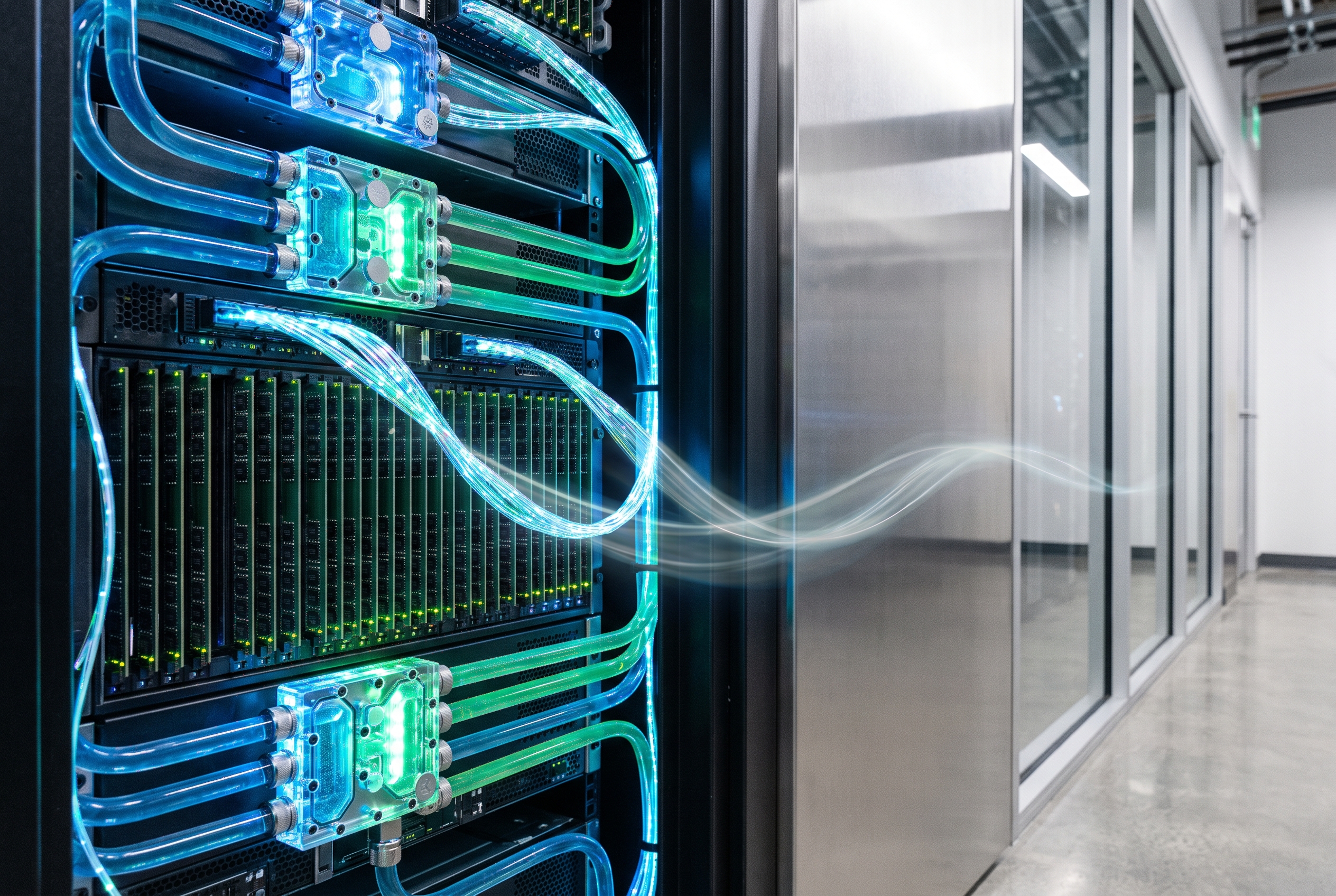
The NVIDIA technical breakdown says each LPU has 500 MB of compiler-managed SRAM and 96 chip-to-chip links at 112 Gbps. LPX puts eight accelerators in each of 32 liquid-cooled compute trays. That design targets the awkward part of serving: moving activations, expert traffic, and state between devices without allowing unpredictable contention to dominate the decode loop.
The proposed division of labor also matters. Rubin GPUs handle flexible, high-throughput work such as prefill and decode attention. LPX accelerates latency-sensitive feed-forward and mixture-of-experts work. In other words, this is heterogeneous serving inside one request path. NVIDIA claims up to 35x higher inference throughput per megawatt than GB200 NVL72 for the combined platform; treat that as a platform claim until independent results cover the same model, context length, precision, and concurrency.
Groq has reported a separate result of 3,400 output tokens per second on Gemma 4 31B with a 100K-token context in Artificial Analysis testing. The company also says it plans to deploy LPX with Vera Rubin NVL72. The important point is not a headline number. It is the direction: hardware vendors now optimize an interactive token path with the same seriousness once reserved for training clusters.
A faster chip will not fix a slow serving system
Low-latency AI inference still fails if the rest of the stack adds variance. Requests cross gateways, schedulers, model servers, caches, databases, retrieval systems, and tool APIs. A fast decode engine cannot recover time lost to a cold model replica, an overloaded queue, or a serial tool call. Infrastructure teams should trace a request across every boundary and keep separate histograms for prefill, decode, routing, retrieval, and tool execution.
Scheduling policy is often the first lever. Separate interactive traffic from bulk summarization and offline embedding jobs. Cap the context length or route unusually long prompts to a dedicated pool. Use admission control when queues begin to threaten the latency budget. Continuous batching can raise utilization, but it also needs guardrails so a giant request does not delay many short ones.
Memory is equally practical. KV caches can consume more capacity than weights for long conversations. Cache reuse, prefix routing, and careful eviction may cut prefill work, but cache locality must be measured per model and tenant. Mixture-of-experts models add another scheduling concern: expert placement and cross-device traffic can turn a nominally fast decode into a tail-latency problem.
What developers and infrastructure teams should do now
Start with a workload map, not a hardware shopping list. Classify requests by prompt size, expected output length, concurrency, tool-call count, and human-facing deadline. Then test the exact model and serving stack at realistic traffic. Report p50, p95, and p99 time to first token and inter-token latency beside throughput. A single tokens-per-second score cannot make a capacity decision.
- Set separate latency SLOs for chat, agent loops, and bulk jobs.
- Measure prefill and decode independently, including cache hit rate.
- Keep long-context and high-priority interactive traffic in distinct queues when contention appears.
- Test failure behavior: replica loss, cache eviction, a slow tool, and a burst of large prompts.
- Evaluate accelerator claims with matched model, precision, context, batch size, and power boundary.
The hardware class is real because the workload is real. General GPUs will remain central for training and broad inference. Purpose-built low-latency AI inference systems will win where predictable token cadence and tail control make the product feel responsive. Developers should design for that split now, while operators build the telemetry to prove which path needs it.
Run and compare models for your own workload on Wiro.