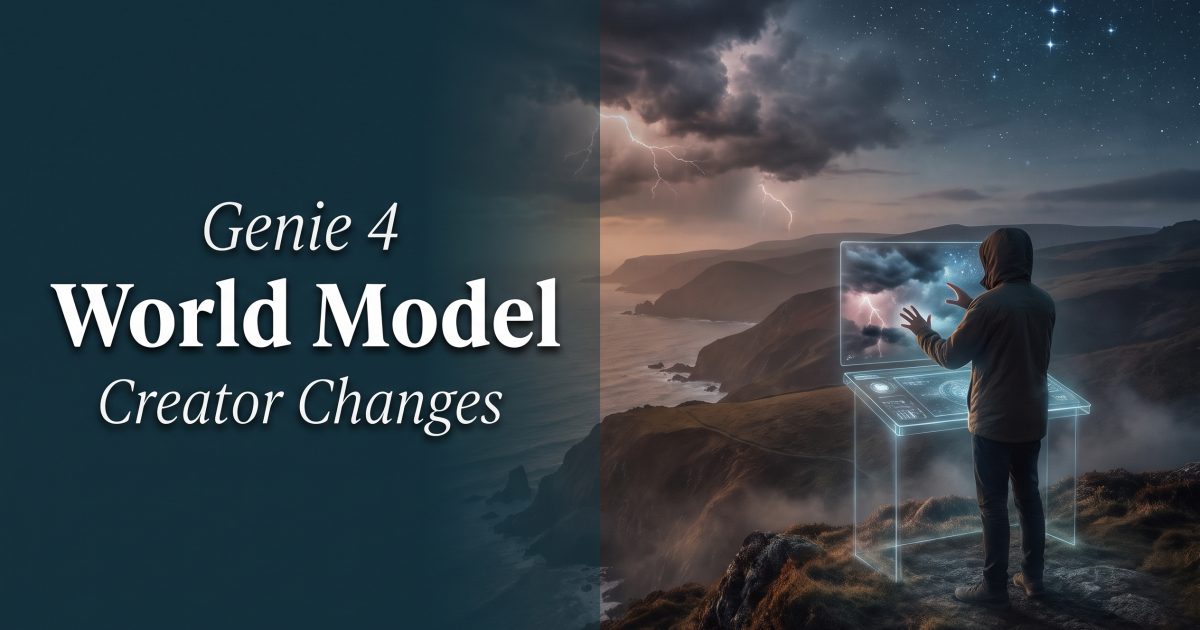
Genie 4 world model is the most interesting generative AI release this week because it treats a scene as something to steer, not just watch. Google DeepMind says the research preview combines real-time simulation, native audio, and language-driven changes inside a running world. That puts it closer to previsualization and interactive concept work than a normal video generator.
It is not a consumer tool yet. Genie 4 is rolling out first to trusted testers, with access planned for Google AI Ultra subscribers in Project Genie and early API partners. That limited release matters. The demos are impressive, but creators should read them as a look at a new interaction model, not a replacement for a production video workflow today.
Why the Genie 4 world model feels different
A standard text-to-video model renders a clip after the prompt is finished. Genie 4 is designed around a live loop: a person can navigate a scene, type a new instruction, and keep moving through the changed result. Google says the model can alter weather, camera position, characters, and events while preserving the surrounding simulation.
The other major change is audio. The Genie 4 announcement describes ambient sound, music, and interactive dialogue generated with the world. That is a different target from adding a soundtrack after render. A scene is meant to react as one object: visual state, sound, movement, and user direction.
DeepMind also says Gemini models help keep the simulation coherent. That could matter more than a prettier frame. A creator can forgive a slightly rough texture in an early previs pass. It is harder to work with a scene that forgets an object, breaks a simple action, or stops making sense after a prompt edit.
4 Genie 4 world model changes for creators
1. Previs can become exploratory
Today, a director often writes several prompts, renders several clips, and selects one. A live world could shrink that loop. Start with a rainy coast, ask for a clear sky, move the camera closer, then introduce a character. The goal is not a final shot at every step. It is faster discovery before a shot list becomes expensive.
2. Audio direction joins the first pass
Native audio changes the questions a creator can ask early. Does a busy street need a distant train? Should a quiet room feel too quiet after a door shuts? In a normal pipeline, those calls land after picture lock. Genie 4 suggests a workflow where sound can influence the scene choice from the beginning.
3. A prompt becomes a control surface
Prompting is usually front-loaded. The Genie 4 world model makes language more like a running controller. The useful skill is not finding one perfect paragraph. It is giving short, specific interventions that keep the intent intact: change the weather, make the crowd disperse, lower the camera, or bring a vehicle into frame.
4. The output could become a prototype, not just an asset
Interactive scenes could help pitch a game level, test a virtual production idea, or explore a training scenario. That does not mean the result is ready for a game engine or a film timeline. It means the early artifact can answer more questions before a team commits to detailed build work.
What a video test can show today
Genie 4 is not currently available on Wiro, so the clips below are not Genie 4 outputs or a benchmark. They use Kling V4 on Wiro to test the closest familiar part of the idea: a short cinematic scene with sound, a changing environment, and a clearly directed camera. They show why a live, steerable version of this workflow is appealing.
The first clip stresses a handoff between weather, lighting, and character action. A conventional video model can create the visual transition in one pass. The missing piece is the ability to pause inside that result, give a new direction, and continue without starting another render. That is the promise behind the Genie 4 world model approach.
The second clip is harder because it asks for social motion, a lighting shift, camera movement, ambience, and dialogue in five seconds. It is a useful reminder that visual plausibility is only one part of a world model. Long-running consistency, readable text, reliable physics, and stable object placement are tougher problems.
Limits and access still matter
DeepMind is explicit about those limits. Genie 4 can drift during longer sessions or after several complex edits. It still has open work around object permanence, spatial accuracy, legible text, physical interaction, and real-time audio accuracy. Generated video and audio will also carry SynthID watermarking.
For now, treat the release as a signpost. The important change is not simply that generated video looks more realistic. It is that generative scenes may become places to explore, revise, and direct while they are alive. That could reshape early creative work long before it replaces a final production pipeline.
Try short, directed video ideas yourself with Wiro, then compare how much control a single render gives you today with the live interaction Genie 4 is aiming for.