AI image generation cost is no longer one number. A creator can buy a monthly bundle, pay only when a prompt works, or bring a capable GPU home. Those choices feel similar at checkout, but they behave very differently when you make 50 images, 300 images plus clips, or a production-scale pile of variations.
This is a creator-side cost check, not a hardware performance review or an investment case. I ran the same ceramic-studio concept through four current tools on Wiro, then used the exact displayed per-output prices for those run settings. For subscriptions, I checked current consumer plan prices on the day of writing. For local work, the comparison uses one available RTX 5080-class board and an explicitly stated electricity assumption.
AI image generation cost: what I priced
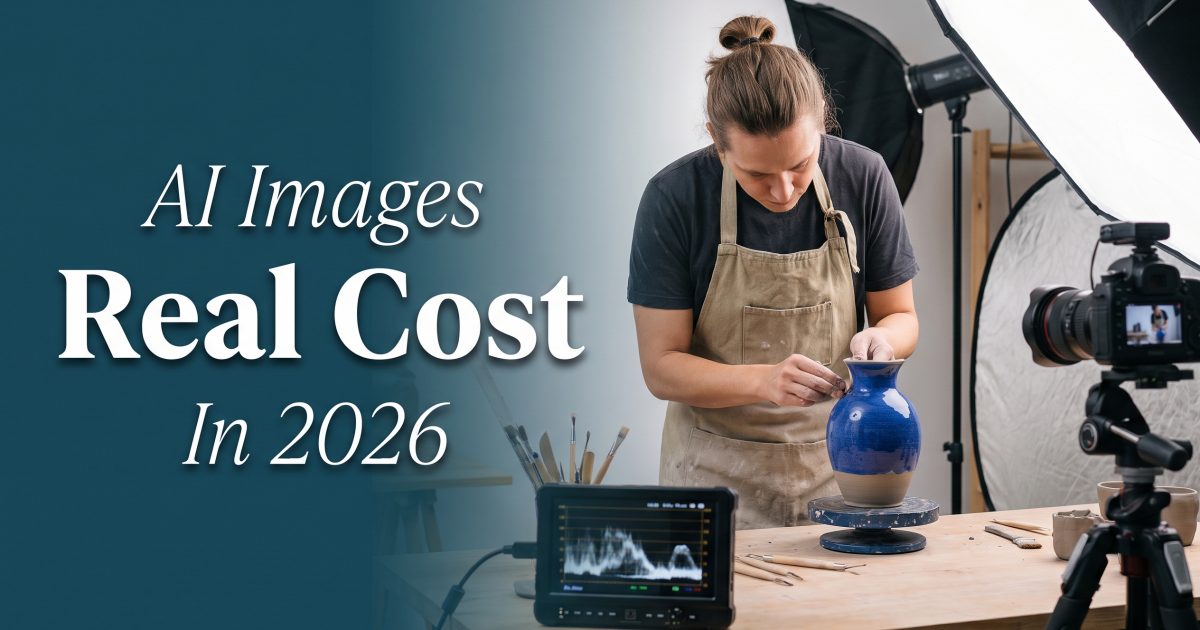
The still prompt was an editorial shot of a solo ceramic artist glazing a cobalt-blue vase in a sunlit studio. The motion prompt turned that scene into a five-second handheld studio shot. This is a useful creator workload: it asks for material detail, believable light, a person, product focus, and modest movement rather than a benchmark chart.
| Model and test setting | Output | Measured price | What that means |
|---|---|---|---|
| Qwen Image 3.0 Pro, 2K, one image | PNG still | $0.085 | 8.5 cents per 2K image |
| Wan 2.7 Image Pro, 2K, one image | PNG still | $0.075 | 7.5 cents per image |
| MiniMax FastH3 V2, 768P, five seconds | MP4 clip | $0.325 | 32.5 cents per short clip |
| P-Video 2 Pro, 768p Quality, five seconds | MP4 clip | $0.375 | 37.5 cents per short clip |
For the profile maths below, I use the midpoint of those two image runs ($0.08) and the midpoint of those two short-video runs ($0.35). That is a transparent test basket, not a claim that every image or clip costs the same. Resolution, duration, quality mode, retries, reference images, and model choice all move the number.


Three creator profiles, priced three ways
Here are deliberately simple monthly profiles. The pay-per-output column is the test basket above: $0.08 per image and $0.35 per five-second clip. The subscription reference is Runway pricing: $12 Standard, $28 Pro, and $76 Max when billed annually. Those plans include credits and model-specific limits, so treat them as plan prices rather than a promise that every possible model mix fits perfectly. In particular, the published allowances show why a heavy creator must check credits before assuming one subscription is unlimited.
| Monthly profile | Pay per output on Wiro | Subscription reference | Own GPU: first month | Practical break-even |
|---|---|---|---|---|
| Light: 50 images | $4.00 | $12 Standard | $1,800.09* | Per-output is cheaper than a $12 plan until roughly 150 similar images/month. |
| Regular: 300 images + 10 clips | $27.50 | $28 Pro is close in price, but its published credit allowance may not cover this mixed workload; Max is $76. | $1,800.72* | Pay-per-output and a lower subscription are nearly tied on sticker price; credits decide it. |
| Heavy: 1,500 images + 60 clips | $141.00 | $76 Max before any top-ups; verify model-specific credit use. | $1,803.58* | A subscription can be cheaper if its credit mix covers the work; otherwise metered spend stays predictable. |
*GPU figure = $1,799.99 for the listed RTX 5080 board plus estimated generation electricity only. I use a conservative planning assumption of 250W average system draw while generating and $0.16/kWh: 4, 28, and 140 generation hours respectively add about $0.09, $0.72, and $3.58. Your card, full PC draw, idle time, cooling, and local utility rate can change this materially. The MSI US store listing showed the $1,799.99 card price when checked, while the U.S. Energy Information Administration table shows why electricity varies substantially by state.
Why the GPU column is not a magic third option
The GPU purchase is not an apples-to-apples substitute for every cloud generation button. An RTX 5080 has 16GB of GDDR7 on the retail listing. That does not make the exact hosted services in this test local installs. Qwen Image 3.0 Pro, Wan 2.7 Image Pro, FastH3 V2, and P-Video 2 Pro were tested here as hosted products; their Wiro pages do not provide a supported consumer-local package and VRAM recipe for reproducing these exact paid configurations. FastH3 V2 is described as H200-backed, and the video tools were used as hosted video services. Do not buy a GPU on the assumption it will reproduce them unchanged.
A GPU does make sense for creators who deliberately choose open local models, work offline, need repeatable private workflows, or already own the rest of the PC. But the upfront card price dwarfs the light and regular metered totals. At the $141 heavy-profile basket, ignoring the small electricity component, $1,799.99 takes about 13 months to equal pay-per-output spend; that is a rough cash comparison, not a guarantee of comparable output quality or local availability.
Plain verdict: pick the payment shape that matches your uncertainty
Light creators: pay per output. Four dollars for 50 representative images is hard for a recurring plan to beat, and it leaves room to try several models instead of forcing one app into every job.
Regular creators: start metered if your volume swings month to month. Move to a subscription when you repeatedly use one service enough to consume its included credits, not because the headline plan price looks low. Keep an eye on failed takes: a cheap plan becomes expensive when it pushes you into a model that misses the brief.
Heavy creators: a subscription can be the simplest budget, but read the credit table against your image-and-video mix. A local GPU is a workflow decision first and a cost decision second; it is best when you will actually use compatible local models often enough to justify the hardware and its setup time.
What changes next
Per-request payment standards such as x402 could make it easier for apps to charge for a generation without wrapping every creator in a subscription. The useful creator outcome would be simpler: pay for the prompt you need, compare the result, and stop paying when the project stops.
Want to test the same prompt and choose by result instead of promise? Run image and video models yourself on Wiro.