
Local AI inference just crossed the line where a software update can change a daily workflow. NVIDIA says new llama.cpp and vLLM optimizations can deliver up to 1.9x faster inference on RTX and DGX systems. That headline needs context: it is a peak result from selected workloads, not a promise that every prompt finishes in half the time. Still, the reported gains are large enough to change how developers size models, structure agent loops, and decide which data stays on-device.
What 1.9x Faster Local AI Inference Actually Means
The useful unit is not a marketing multiplier. It is elapsed time at each stage of a request. Autoregressive models first read the prompt and build a KV cache. That prefill phase can dominate when an agent loads a repository, a long ticket thread, or a set of PDFs. The model then generates tokens one by one. A faster decode rate makes a chat response feel snappier; faster prefill makes retrieval-heavy and tool-using work less sticky.
NVIDIA attributes the up-to-1.9x figure to improvements in llama.cpp and vLLM, including faster prefill, speculative decoding, XQA attention kernels in FlashInfer, and backend work. The company lists a 50% token-throughput gain for Qwen3.6-27B and a 90% gain for Qwen3.6-35B on a GeForce RTX 5090 in its cited tests. Those are model-specific results. Quantization, context length, batch size, temperature, GPU memory, and the serving stack all change the number.
That distinction matters. A 90% throughput gain does not make a 90-second agent task take 47 seconds if document parsing, retrieval, tool calls, or human approval account for most of the wall-clock time. It can, however, turn a 10-token-per-second coding model into a roughly 19-token-per-second experience in a favorable decode-bound case. The difference is felt on every repair loop, not just on a dashboard.
Why the Workflow Changes
Local AI inference earns its place when requests are repeated, sensitive, or latency-sensitive. A developer reviewing a pull request may ask a model to read a diff, inspect tests, propose a patch, and rerun a local command several times. Each round has a small wait. Cut that wait substantially and people ask more follow-up questions, keep more context in the session, and abandon fewer half-finished agent runs.
Privacy is the other practical shift. NVIDIA describes local agent paths for engineering work, financial records, and startup funnel data, with selective escalation to cloud models only when extra research or reasoning is needed. Keeping source code, customer exports, credentials, and internal documents on a controlled machine narrows data movement. It does not remove the need for access controls, audit logs, or a clear policy for any cloud fallback. It gives teams a useful boundary to enforce.
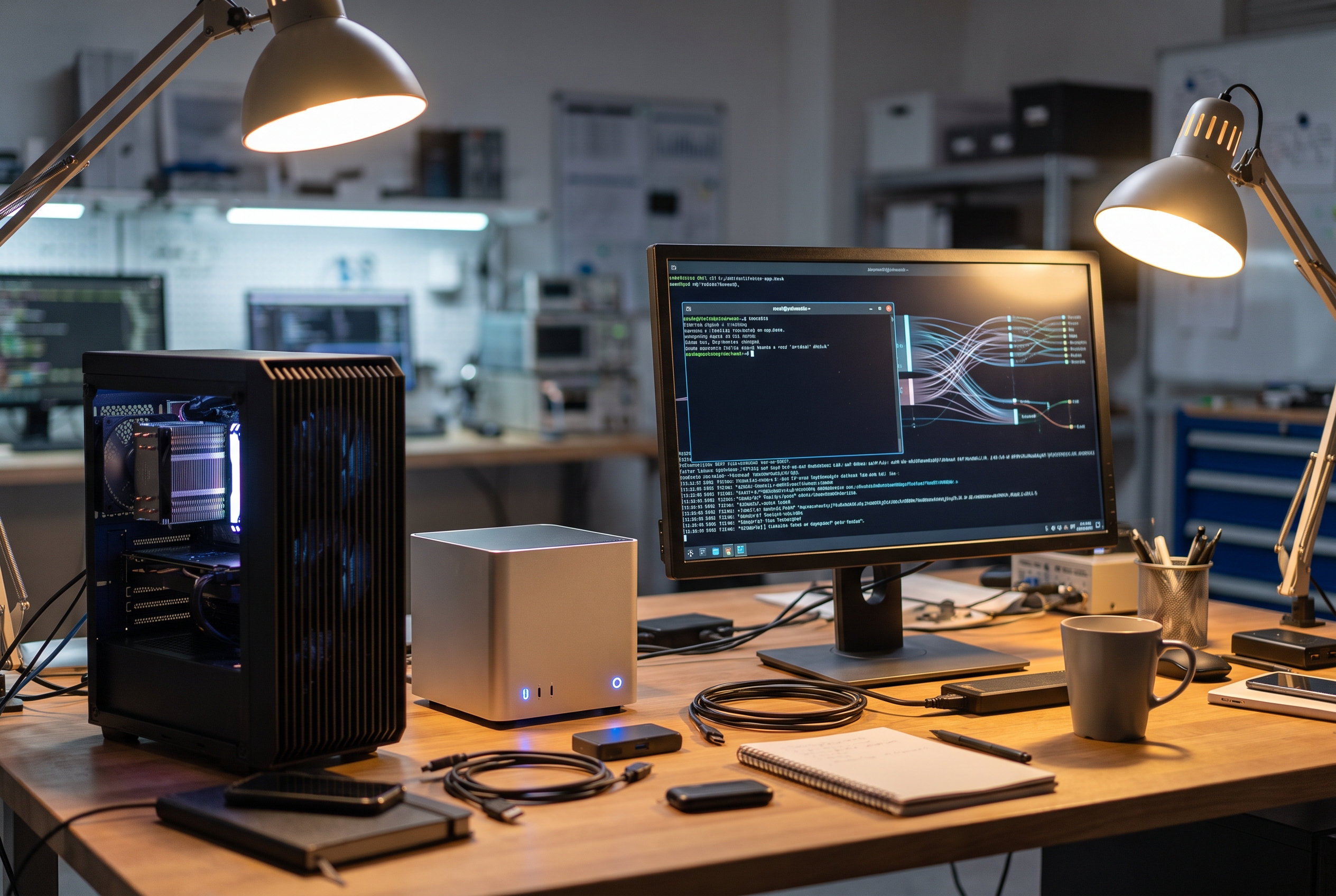
The new setup layer matters as much as kernels. NVIDIA says Hermes Agent, the underlying runtime, and Perplexity Portable Computer are adding simpler local model setup, with automatic GPU detection and integrated llama.cpp paths in some cases. That reduces the tax of choosing a model format, downloading the right quantization, matching CUDA dependencies, and remembering which launch flags worked last week. Faster local AI inference is most valuable when that setup stays boring.
Measure the Whole Request, Not Just Tokens Per Second
Infrastructure teams should record at least five numbers before changing hardware or declaring a win:
- Time to first token: captures prompt ingestion and queueing. It often reveals long-context pain.
- Decode throughput: tokens per second after generation begins. Track it at the same model, quantization, context length, and batch size.
- End-to-end task time: includes retrieval, tool calls, parsing, and retries. This is the number users notice.
- VRAM headroom: leave space for the model weights, KV cache, embeddings, and concurrency. A model that barely fits can fall apart under parallel use.
- Power and noise at the intended duty cycle: a desktop agent running all day has different constraints from a five-minute benchmark.
Run a fixed test set. Use a short code question, a 16K-token document summary, a retrieval-augmented request, and a multi-step tool task. Log median and p95 results, not only the fastest run. Warm-cache and cold-start results should sit in separate columns. This makes it possible to see whether a new kernel helps prompt ingestion, output generation, or neither for the real workload.
There is also a capacity angle. Faster prefill and decoding can let one local server handle more useful work before users queue. That does not mean capacity rises by the same 1.9x. Memory bandwidth, available VRAM, model architecture, and concurrent sequence count set the ceiling. For a single developer, lower waiting time may be the entire win. For a platform team, predictable p95 latency and fewer out-of-memory failures usually matter more.
A Practical Local Deployment Checklist
Start with the model, then work backward to hardware. A 27B parameter model needs far less memory in a 4-bit format than at FP16, but quantization can affect quality, throughput, and tool-use reliability. Test the exact model file and serving engine you plan to use. Do not compare a small quantized model against a larger model at different context limits and call the result a hardware benchmark.
Next, pick a serving layer for the shape of the job. llama.cpp remains a useful choice for single-user and broad hardware support. vLLM is built for high-throughput serving and continuous batching. The NVIDIA IFA 2026 announcement says its latest work reaches both paths, plus integrations through LM Studio and Ollama. That is good news, but each integration should be tested after an update rather than assumed to inherit every upstream gain.
Finally, keep the boundary clear. Local inference does not mean every component stays local. Agents may browse, call SaaS APIs, fetch package metadata, or send telemetry. List those paths. Require permission before sending sensitive content outside the network. Version prompts, model weights, and runtime settings so a faster update can be rolled back if quality changes.
The Bottom Line for Local AI Inference
The 1.9x claim is not a universal performance guarantee. It is a strong signal that the local stack is improving at the runtime level, where users feel delays. For developers, that can mean tighter coding loops and more private context. For infrastructure teams, it means benchmarks should cover prefill, decoding, tail latency, memory pressure, and the full agent task. The right response is not to chase a headline. It is to rerun the workload that currently wastes the most time.
Run models for your own workload on Wiro, then compare the output quality and latency against the local setup you can actually operate.