AI agent routing decides which model, tool, and review path handles each step of an agent task. That sounds like an optimization detail, but it shapes reliability, latency, and operating cost. Teams building production agents should not send every request to the largest available model. They should send bounded work to a fast route, reserve deeper reasoning for tasks that need it, and send current facts or external actions through tools with explicit checks.
AI agent routing starts with task shape
Routing is not a leaderboard of models. It is a decision made before a model call: what output is needed, how expensive a wrong answer would be, whether the task needs fresh data, and how long the caller can wait. A request to normalize a support ticket into JSON has a different failure mode from a request to plan a database migration. Treating them as identical work wastes capacity and makes incidents harder to diagnose.
Anthropic describes routing as classifying an input and directing it to a specialized follow-up task. That separation matters because prompts tuned for one category can reduce performance on another. Its guidance also draws a useful boundary: predefined workflows give predictable paths for well-defined work, while agents earn their flexibility when the system cannot know the right sequence in advance. Read the original agent workflow guidance for the architectural distinction.
Build a small routing policy
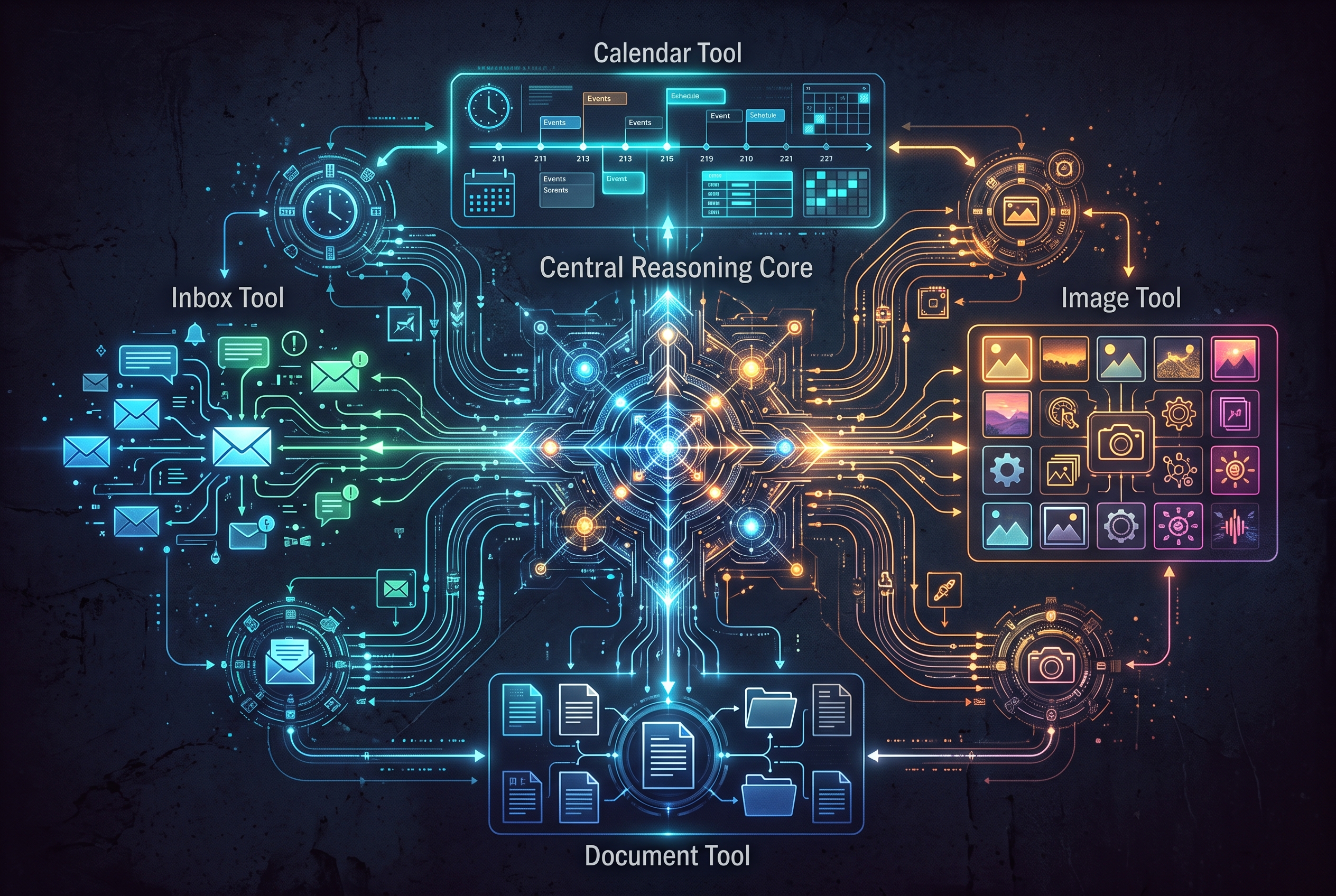
Start with four routes. The fast route handles extraction, tagging, language detection, formatting, and simple summaries. The reasoning route handles ambiguous planning, code review, multi-constraint decisions, and work where a flawed answer triggers rework. The tool route fetches current records, performs calculations, reads files, and executes approved actions. The creative route sends image, video, or audio work to a specialist model instead of asking a text model to imitate those capabilities.
Keep the first classifier boring. A ruleset can identify obvious cases with fields such as task type, requested output schema, data sensitivity, and action level. A compact model can classify the remainder. Use a confidence threshold such as 0.80 as an initial operating setting, then route lower-confidence requests to a stronger classifier or a safe human-review path. That number is not universal. It is a starting point to evaluate against real traffic.
Every route needs a fallback. If structured output fails schema validation twice, retry once with a repair prompt and then escalate. If a tool response has no source timestamp or returns a partial record, stop rather than letting a language model fill gaps. If a reasoning route reaches a token or time budget, return the evidence gathered so far and request a decision. These exits prevent a cheap route from becoming a silent source of expensive errors.

Use route contracts, not vague model labels
A route contract should name the allowed inputs, output format, maximum retries, tool permissions, and acceptance test. For example, an extraction route might accept one document under 20 pages, return a fixed JSON schema, allow no external writes, and fail if any required field is absent. A planning route might accept retrieved evidence plus a ticket, return ranked options with citations, and require human approval before a change request is created.
Those contracts give platform teams something testable. Model names change. Context limits, latency, and model behavior change too. A contract lets a team replace the model behind a route without rewriting every application that calls it.
Measure quality, latency, and cost together
A routing system needs more than a success flag. Log the selected route, classifier confidence, model version, input and output tokens, tool calls, retry count, wall-clock latency, and the final evaluator result. Split latency into queue time, model time, and tool time. A p50 alone hides the requests users remember; track p95 and p99 for each route.
Build a labeled evaluation set before changing policy. A useful first set has 100 to 300 representative tasks, including easy cases, ambiguous cases, malformed inputs, stale-data traps, and high-impact actions. Score the final output against a task-specific rubric. For extraction, measure valid JSON and field accuracy. For code review, measure accepted findings and false positives. For a support route, measure correct destination and safe handling of missing account context.
Compare a routing policy against a simple baseline: one capable model, one prompt, and the same evaluation set. The route earns its added moving parts only if it preserves or improves the task score while meeting a stated latency or budget target. AWS makes the same practical warning in its multi-LLM routing overview: a classifier can add cost and latency of its own. Count that overhead in the decision.
Set budgets that cause an observable behavior. A 2-second interactive route might fall back to a concise response at 1.6 seconds. A 30-second research route might permit three retrieval calls and one synthesis pass. A write-capable route should stop before execution if its evidence bundle lacks the record identifier, authorization state, or expected side effect. Numbers make policy review concrete.

Treat tools and context as routes
Model selection alone cannot fix stale or overloaded context. Current inventory, account state, incident status, and calculations belong behind tools that return inspectable data. The language model should explain or choose from that evidence, not invent it. Put authorization and idempotency checks in the tool layer. A model may propose an action, but the tool should reject an unapproved or duplicate request.
Context has a cost beyond token billing. Anthropic notes that attention across a transformer context involves n squared pairwise relationships, and that long context can reduce precision for retrieval and long-range reasoning. The practical response is to pass a short, source-labeled evidence bundle to the route that needs it, not a transcript dump. The context engineering analysis explains why context should be treated as a finite resource with diminishing returns.

A practical rollout for infrastructure teams
Run routing in shadow mode first. Let the proposed policy choose a route while production still uses the known baseline. Record the hypothetical route, predicted confidence, expected token use, and evaluation outcome. After enough representative traffic, review the false routes. Most early failures come from task definitions that overlap, not from a missing model tier.
Next, release one low-risk route such as classification or document extraction. Use feature flags by tenant or workload. Keep a kill switch that sends traffic back to the baseline. Alert on schema failures, tool-error rate, route distribution shifts, and a sudden p95 increase. Routing drift is often visible before users complain: a new prompt can move 40 percent of traffic from the fast path to the reasoning path overnight.
Finally, review the policy every two to four weeks. Remove routes that do not earn their complexity. Move tasks when evaluation data shows a smaller model meets the contract. Add human review around publishing, spending, permissions, and private data. The strongest routing systems are small enough to inspect and strict enough to explain why each decision happened.
AI agent routing is not just cost control. It creates a clearer boundary between model reasoning, reliable tools, and human accountability. Explore models and build an agent workflow on Wiro.