
AI agent hardware is becoming an efficiency problem, not only a scale problem. A useful agent can read a long context, reason through several steps, call tools, inspect returned data, and write a response. Each stage moves data and produces tokens. That changes the buying question for developers and infrastructure teams: not “Which accelerator has the highest peak number?” but “How much useful agent work can this system deliver inside a latency and power budget?”
Why agent workloads behave differently
A simple chat completion has a relatively clean shape: prefill the prompt, then decode output tokens. Agent traffic is less tidy. A request may begin with a large system prompt and a growing conversation history. It may then pause for a retrieval query, a code sandbox, a database lookup, or an API call. The next model call includes those results, often with a larger prompt than the first. Parallel subagents make the pattern even less predictable.
This matters because prefill and decode stress hardware differently. Prefill works through many input tokens and can benefit from batching. Decode produces one token at a time for each active sequence and is often limited by memory bandwidth, cache management, and the latency target. Long contexts add another constraint: the key-value cache stays resident while attention works across prior tokens. If the cache spills or gets moved between machines, responsiveness suffers before arithmetic throughput becomes the headline issue.
Reasoning models raise the stakes. They can generate substantial intermediate token counts before returning a short final answer. A workflow that looks cheap in a UI can turn into a high-token service once it handles retries, tool feedback, and concurrent users. Hardware efficiency therefore needs to cover tokens per second, time to first token, tail latency, memory capacity, and watts consumed. A single offline throughput figure cannot explain all of that.
AI agent hardware and the efficiency benchmark
MLPerf Inference remains a useful external reference because it defines scenarios and accuracy targets rather than accepting a vendor-picked demo. Its datacenter suite tests both offline and server-style workloads. The distinction matters. Offline results show how much work a system can clear, while server tests impose response constraints that are closer to a production endpoint.
The MLPerf Inference v5.0 results added Llama 3.1 405B, Llama 2 70B Interactive, and a graph neural-network workload. NVIDIA reported that GB200 NVL72 reached up to 3.4 times higher per-GPU performance than an H200 eight-GPU system on the Llama 3.1 405B benchmark. It also reported up to 30 times system-level throughput on that workload, combining faster GPUs with a 72-GPU NVLink domain. Those are vendor-reported benchmark comparisons, not a promise for every application, but they show why the unit of analysis has shifted from a single card to a rack-scale design.
In the v5.1 round, NVIDIA reported that GB300 NVL72 delivered 45% higher DeepSeek-R1 offline throughput per GPU than GB200 NVL72, and about five times Hopper-based throughput. The same report describes a 2-second time-to-first-token threshold and a 12.5 tokens-per-second-per-user target at the 99th percentile for the DeepSeek-R1 server scenario. Those service-level limits are closer to what an interactive agent owner actually feels than a peak FLOPS rating.
Precision is part of the efficiency story, but it is not a free win. Blackwell systems use FP4 or NVFP4 paths to reduce model footprint and increase throughput. The v5.0 report states that FP4 can provide twice the peak throughput of FP8 while meeting benchmark accuracy requirements. Teams should still validate output quality, tool-call structure, and failure rates on their own prompts. A quantized model that needs extra retries can erase a large portion of the apparent hardware saving.
The system matters as much as the chip
Agent serving turns the network into a first-class resource. Large models split across accelerators need fast collective communication. Mixture-of-experts models add token routing between expert groups. When a scheduler moves a request, it may also need to preserve or rebuild its key-value cache. Slow links and weak topology show up as jitter, not just a lower benchmark score.
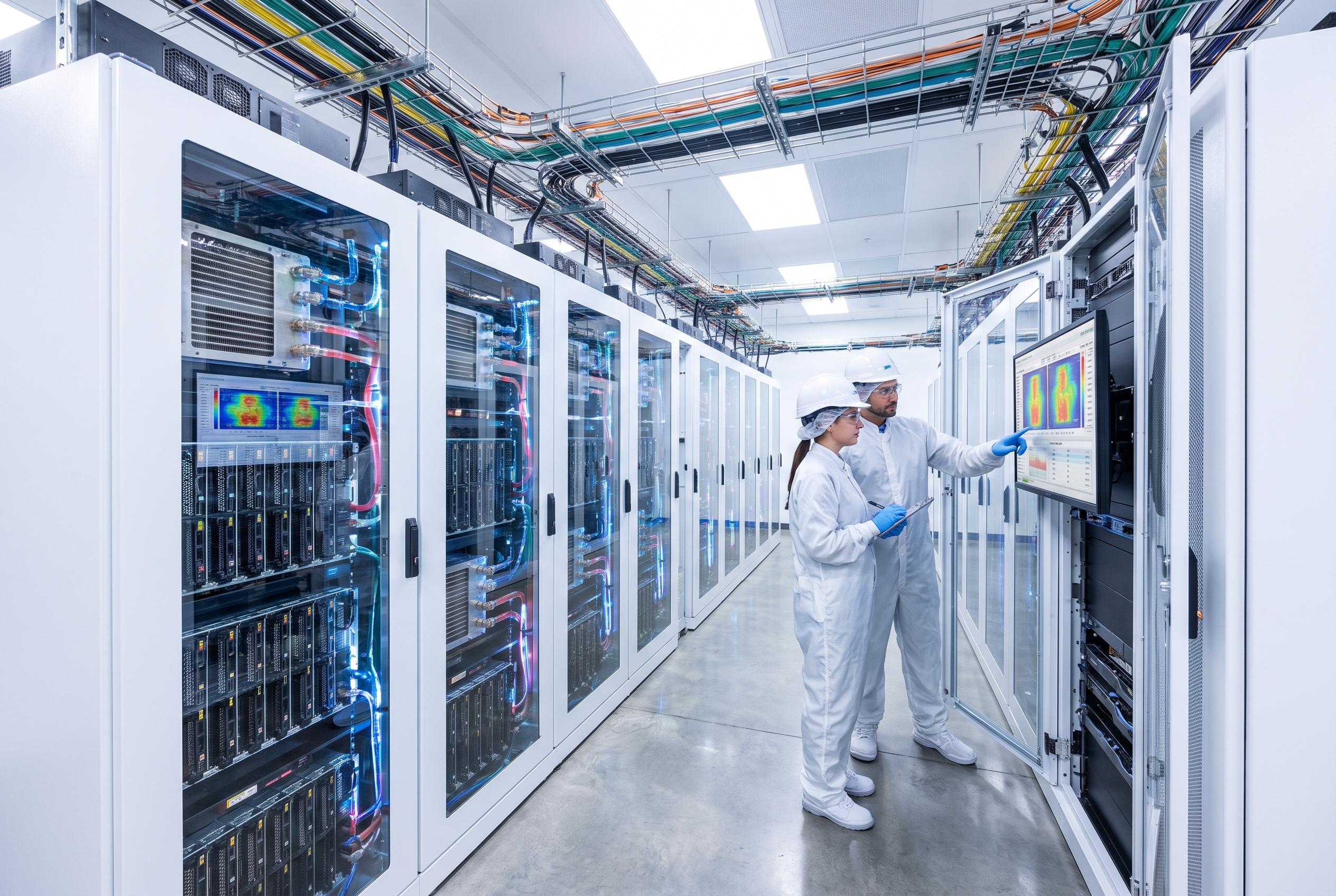
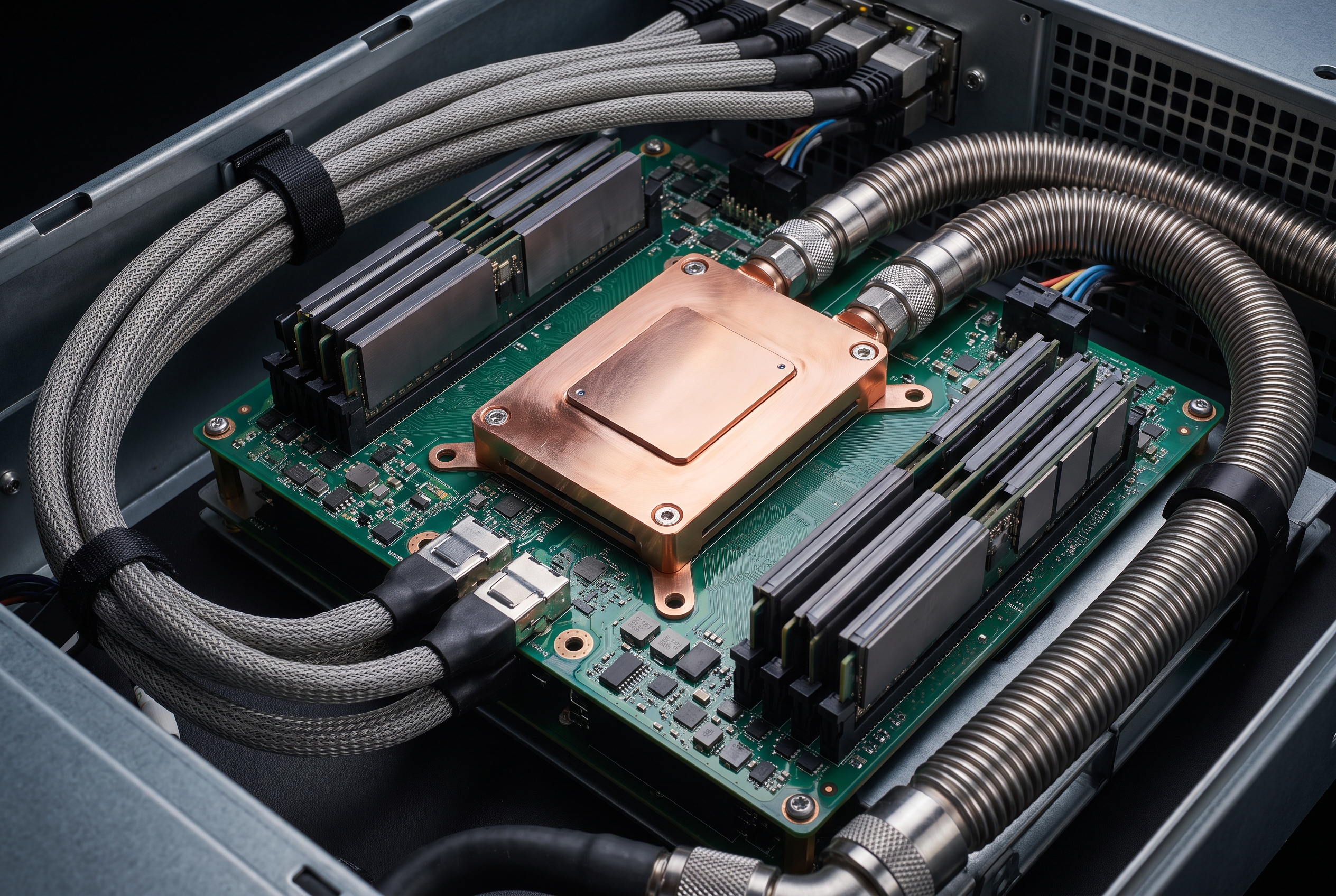
Memory capacity decides how much context and how many concurrent sessions can remain active. Memory bandwidth affects token decode. Interconnect bandwidth and latency affect tensor parallelism and expert parallelism. Cooling and power delivery set the sustained operating point. That is why a rack with strong accelerators can still disappoint if it cannot hold clocks, feed the network, or schedule requests without cache churn.
Software changes the outcome too. NVIDIA attributes recent MLPerf gains to kernel work, chunked prefill, pipeline parallelism, quantization, and disaggregated serving. Its v5.1 write-up reports nearly 1.5 times higher throughput from disaggregated serving than traditional aggregated serving for Llama 3.1 405B interactive workloads on GB200 NVL72. The practical idea is simple: separate prefill-heavy work from decode-heavy work when the traffic shape supports it. That lets each pool tune batch size, memory use, and scaling rules for its job.
What developers and infrastructure teams should measure
Start by tracing a complete agent task, not one isolated prompt. Record input tokens, generated tokens, tool-call count, context growth, cache hit rate, retries, and concurrency. Split the trace into prefill, decode, tool wait, and post-processing. That reveals whether a workload needs more memory, better batching, a lower-latency decode tier, or fewer model calls.
Then set an explicit service objective. A customer support agent may need a fast first token and steady streaming. A research agent may tolerate a slower response if it completes more tool steps correctly. Track p50 and p99 time to first token, inter-token latency, task completion rate, watts, and cost per successful task. Tokens per dollar is useful, but only after quality and response targets are met.
Benchmark with production-shaped prompts. Include the actual tool schemas, long retrieved documents, structured outputs, and bursts of simultaneous sessions. Run a small load sweep instead of one maximum-throughput test. Watch what happens when the key-value cache fills, when a tool stalls, or when a model retry occurs. These are ordinary agent events, and they expose bottlenecks that a clean synthetic prompt hides.
Capacity planning should leave room for those events. A design that looks efficient at a fixed batch size may have poor tail latency when traffic becomes uneven. Separate pools for prefill and decode can help, but they add routing and observability work. For smaller deployments, a simpler shared pool with good cache locality may be the better trade. The correct answer depends on the trace, not on an architecture diagram.
Efficiency is now a product metric
The most useful AI agent hardware benchmark is a completed task under a real service target. Accelerator generations will keep improving raw throughput, but agent systems expose every weak link: memory, network, scheduler, cooling, and model runtime. Teams that measure the full path can turn those details into a clear infrastructure decision. Teams that buy only on peak compute will often pay for capacity their agents cannot use.
Run current visual models and build test assets for your own workflows on Wiro.