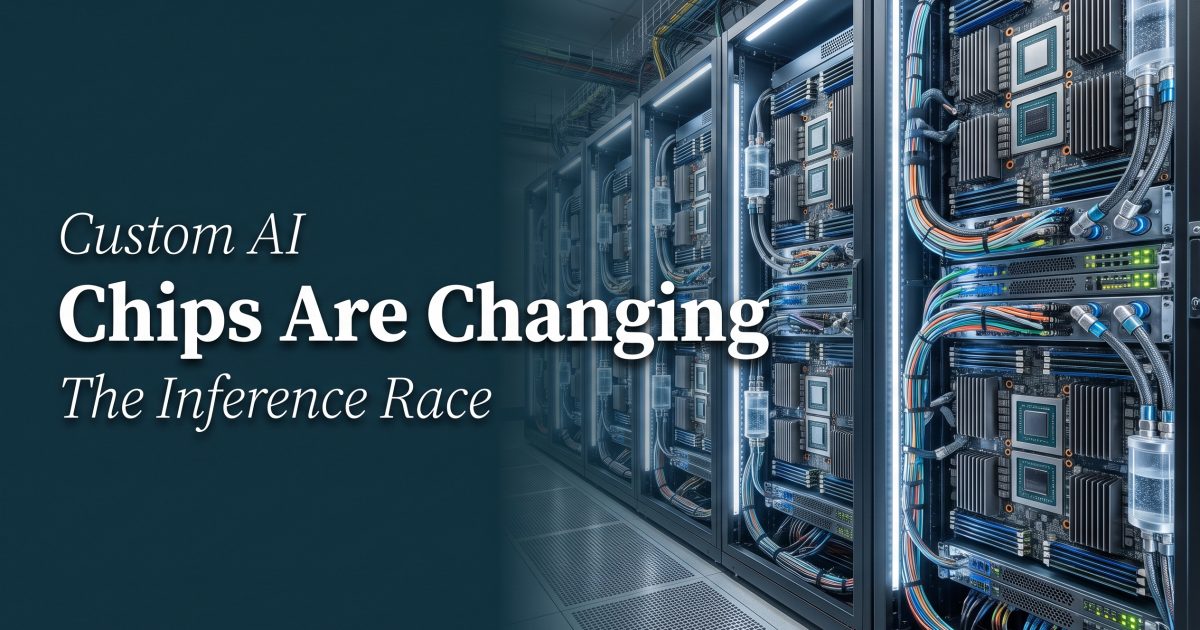
Custom AI chips are moving from an experiment to a product strategy because inference has become the daily bill for modern AI. Training still attracts attention, but every chat reply, code completion, image request, and agent step runs through an inference stack. At that scale, a chip designed around token generation can change latency, power draw, and the number of users a service can support.
The shift is not about replacing GPUs overnight. It is about matching silicon to workloads that repeat at high volume. General-purpose accelerators remain flexible and widely supported. Custom AI chips make a different trade: less universal hardware, more control over memory, networking, compilers, and the exact path a request takes through a data center.
Why custom AI chips now target inference
Large language model serving has two very different phases. Prefill reads the prompt and builds the model state. It tends to lean on compute. Decode produces one token at a time and repeatedly reads weights and the growing KV cache, so memory bandwidth and data movement often become the constraint. A chip can look fast in a raw FLOPS chart yet disappoint when a live application needs low time-to-first-token and steady token-by-token output.
OpenAI’s Jalapeno results make that distinction explicit. The company reported 1.5x to 1.9x more AI work per watt at peak throughput, 1.7x to 3.6x lower end-to-end latency, and 2.1x to 4.1x higher performance on interactive workloads across three public models. It rated the accelerator at 700 watts and said sustained measured power stayed at or below 550 watts on the tested workloads. Those are vendor measurements, not a universal scorecard, but they show what custom AI chips are trying to optimize: useful work at a defined user experience, not an isolated chip number.
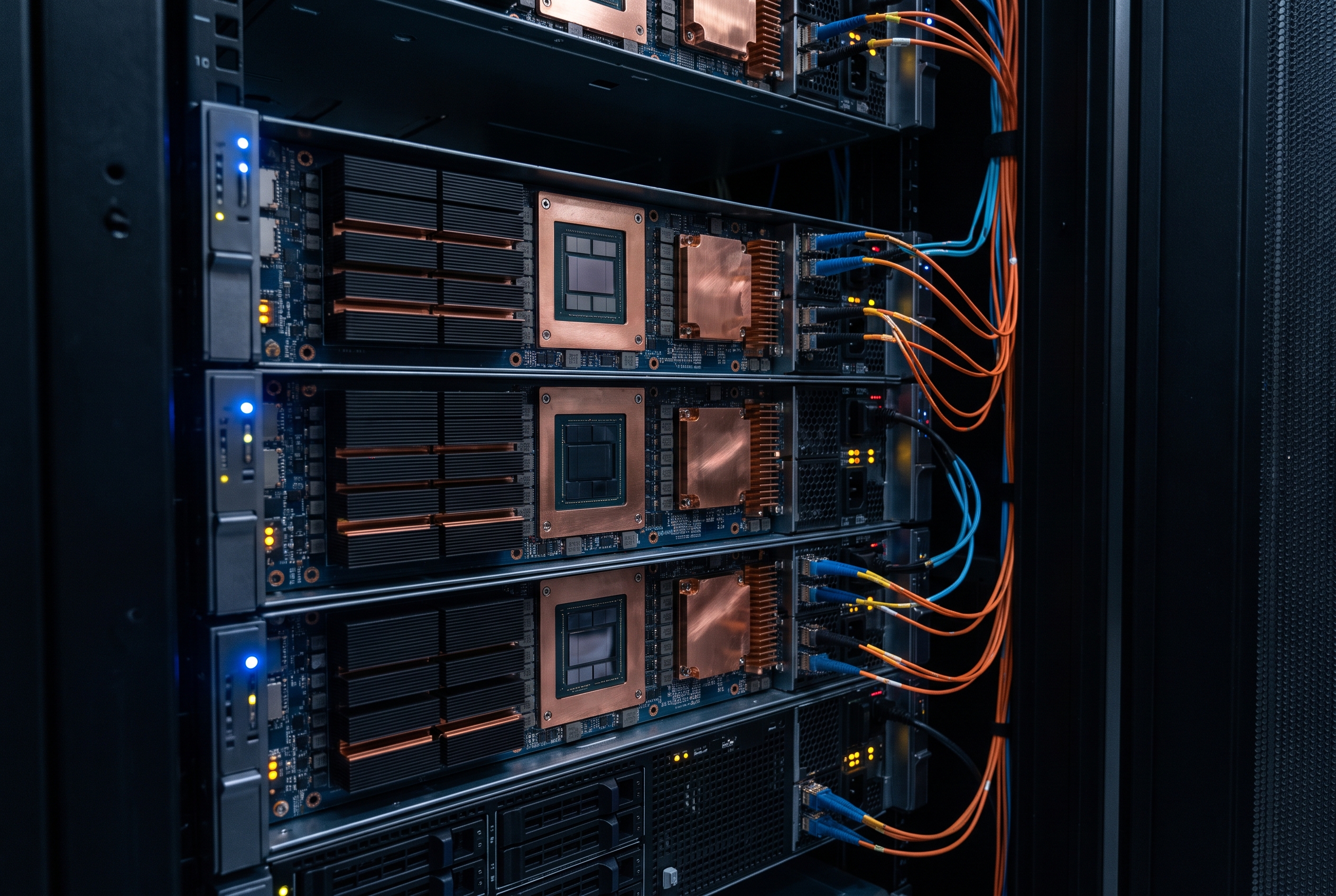
Cloud providers are taking the same full-stack route. AWS describes Trainium3 as an eight-core design with up to 2x MXFP8 compute throughput versus Trainium2. Its published specification lists 144 GB of HBM3e per chip and 4.9 TB/s of memory bandwidth, 1.7x the prior generation. AWS also lists up to 28.8 Tbps of aggregate scale-out bandwidth per UltraServer. Those numbers matter because a fleet does not serve models from one chip. It serves them through many accelerators, host CPUs, switches, schedulers, and failure domains.
Memory is the real race inside custom AI chips
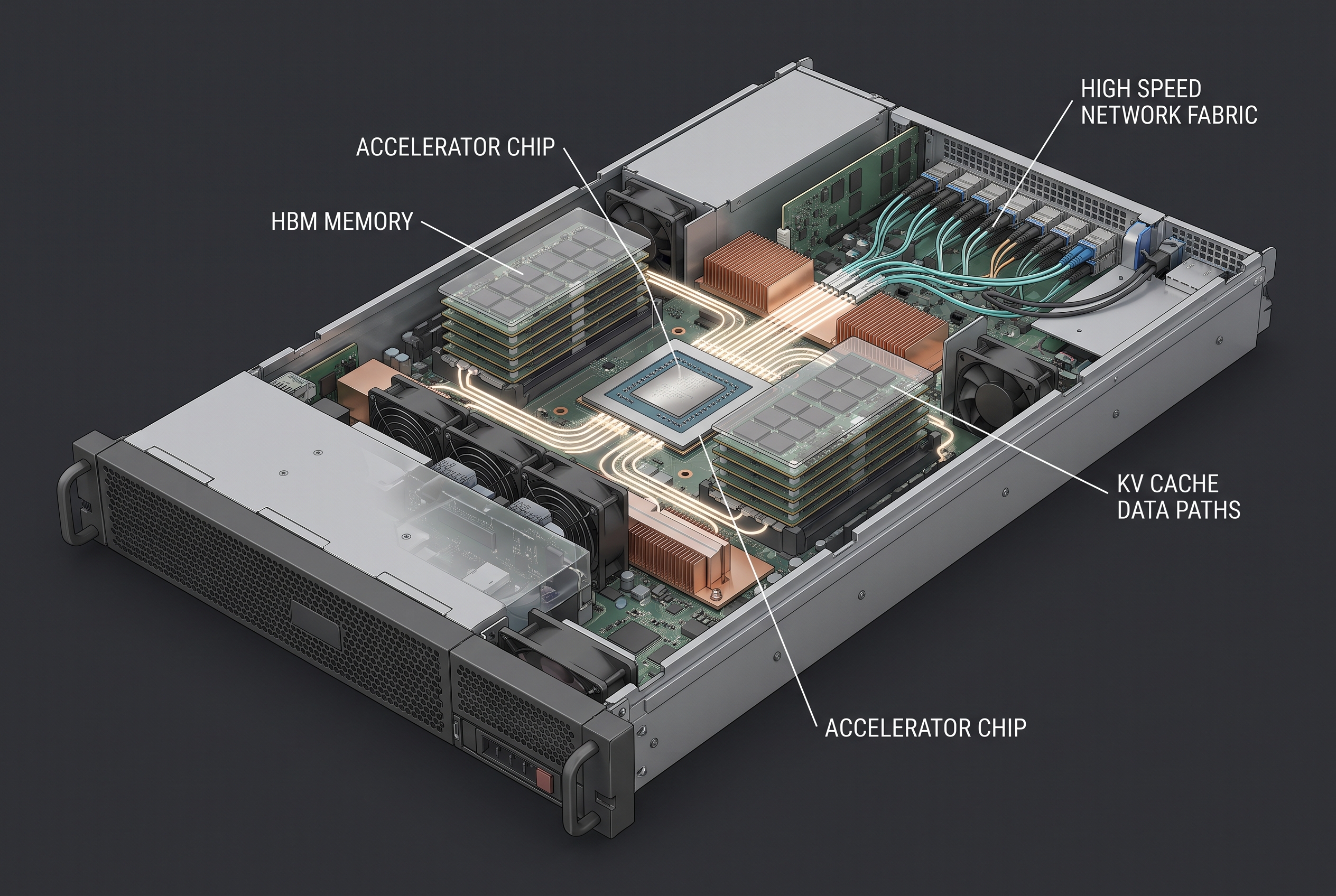
For long-context chat and agent workloads, the KV cache is a first-order infrastructure cost. Each generated token needs access to prior attention state. If that state sits far from compute, the hardware waits. If it moves across a congested fabric, tail latency rises. A custom design can make deliberate choices about HBM capacity, on-chip SRAM, cache placement, quantization support, and how work moves between prefill and decode.
That is why memory claims deserve more attention than peak arithmetic claims. AWS says Trainium3 uses a two-level SRAM hierarchy and hardware W4A8 quantization to increase effective weight-loading rate. Microsoft says its Maia 200 inference accelerator pairs 216 GB of HBM3e with 7 TB/s of bandwidth and 272 MB of on-chip SRAM. The specifications are not directly comparable across chips or model formats. They do, however, point to the same engineering reality: serving a large model means keeping weights and state close enough to avoid wasting expensive compute cycles.
Custom AI chips also let teams co-design numerical formats with serving software. Lower-precision weights can reduce bandwidth pressure, but only if kernels, calibration, quality checks, and fallback paths support them. A production stack needs to know which models tolerate a format, which layers remain sensitive, and whether the speed gain survives at the target context length and concurrency.
The system, not the die, decides user latency
A single request can touch a router, a queue, one or more model replicas, a cache, and an output stream. In a mixture-of-experts model, it can also trigger routing and collective communication across devices. That makes interconnect design part of inference quality. Slow or oversubscribed links can turn a fast accelerator into an expensive idle machine.
Custom silicon programs increasingly package the chip with the fabric. AWS describes dedicated collective cores and a 144-chip Trainium3 UltraServer with 20.7 TB of HBM3e. OpenAI describes a connected system built to keep model state local and reduce communication delays. The practical point is simple: compare a serving system at the rack or cluster boundary, not only by a chip’s peak throughput.
| Metric | Why it matters | Common failure mode |
|---|---|---|
| Time to first token | Shows prompt-processing and queue delay | Long prompts overwhelm prefill capacity |
| Inter-token latency | Controls how responsive streaming feels | Memory or KV-cache reads stall decode |
| Tokens per second per watt | Links capacity to power and cooling limits | High throughput hides excess power draw |
| Tail latency | Captures the slow requests users remember | Network contention and uneven batches |
| Compiler coverage | Determines whether model changes deploy quickly | Unsupported operators force rewrites |
What developers and platform teams should test
Start with the application, not the marketing slide. Measure prompt lengths, output lengths, concurrency, streaming requirements, model size, and retrieval behavior. A short customer-support reply and a 100-step coding agent produce different pressure on the same hardware. Agent chains are especially sensitive because several modest delays add up before the user sees a finished result.
Run benchmarks at a fixed service-level objective. Record time to first token, inter-token latency, end-to-end latency, throughput, error rate, and power where available. Then repeat under burst traffic and mixed prompt sizes. Average tokens per second alone will miss queueing problems that show up only at the 95th or 99th percentile.
Portability belongs in the evaluation too. Custom AI chips gain their edge through specialized software, so the compiler and runtime are part of the purchase. AWS says its Neuron stack supports PyTorch, vLLM, Hugging Face, and Ray. That reduces adoption friction, but teams should still run their own model, tokenizer, quantization path, observability stack, and autoscaling policy. A kernel gap discovered after a migration can erase a paper efficiency gain.
Capacity planning also needs a new unit: useful tokens per constrained resource. In one site that resource may be rack power. In another it may be HBM capacity, network ports, or an operations team that cannot maintain several execution backends. The cheapest accelerator is not automatically the lowest-cost service when retries, engineering time, and idle capacity are included.
Practical takeaways for the inference race
- Benchmark at matched latency and quality targets, not peak throughput alone.
- Separate prefill and decode measurements. They fail for different reasons.
- Track KV-cache capacity and memory bandwidth alongside compute throughput.
- Test long contexts, burst traffic, and tail latency before committing a model fleet.
- Treat compiler support, kernel coverage, and observability as hardware requirements.
- Keep a portable path for workloads that need the flexibility of widely supported GPUs.
Custom AI chips will not end the GPU era. They will make the inference market less uniform. Providers with predictable, high-volume workloads can tune the whole path from model graph to rack fabric, then turn those gains into faster responses or more capacity under the same power envelope. Developers do not need to predict a single winning chip. They need a benchmark harness that makes latency, quality, energy, and software effort visible before a platform decision locks in.
Run current creative models and compare their real outputs on Wiro.