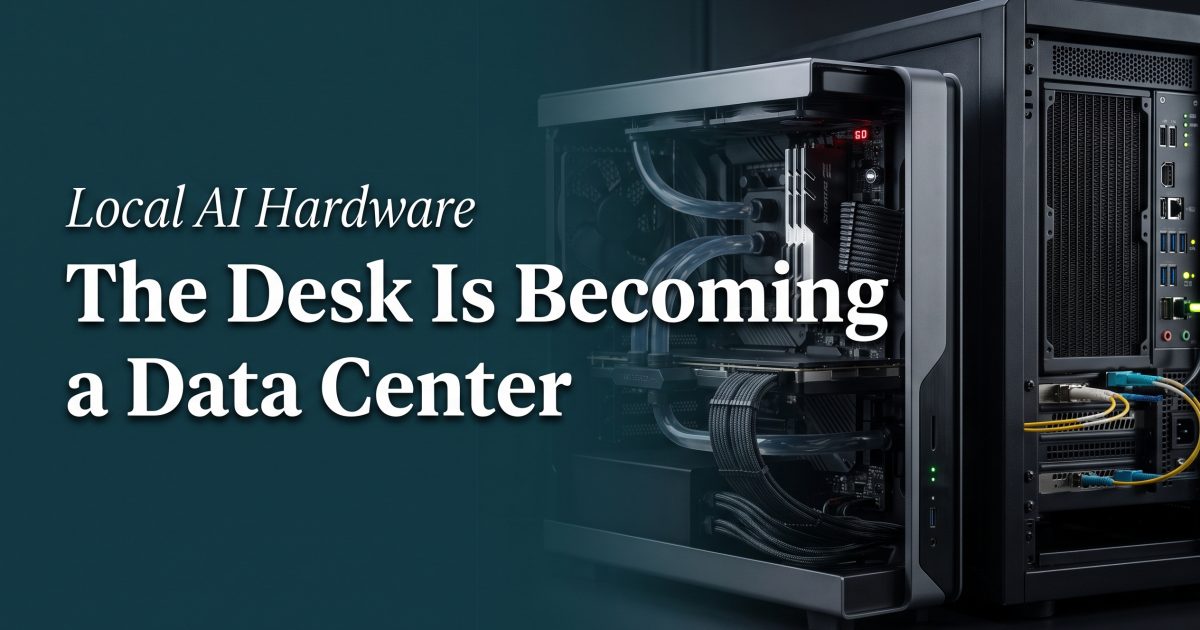
Local AI hardware is no longer a niche setup for people compiling kernels in a garage. In 2026, the desk can host a serious inference node: one that runs private document search, coding assistants, small agents, image tools, and parts of a media pipeline without sending every request across the internet. Cloud inference still wins for many frontier jobs. The change is that teams now have a credible local tier between a laptop demo and a rack-scale deployment.
Why local AI hardware is having a moment
The shift is partly silicon and partly software. NVIDIA describes its DGX Spark as a GB10 Grace Blackwell desktop platform with 128GB of unified system memory, enough to fine-tune models up to 70 billion parameters according to its official product page. That does not mean every 70B model will feel quick, or fit at every precision. It does mean model selection has become a capacity-planning exercise instead of an automatic cloud decision.
At IFA 2026, NVIDIA also announced local inference optimizations claiming up to 1.9x faster performance in llama.cpp and vLLM, plus NVIDIA PAIR for routing work across RTX PCs on a local network. The same update points to 30B-class agent and coding models, and a 284B mixture-of-experts model with 13B active parameters that can run on a two-node DGX Spark cluster. Those are vendor claims, not a universal benchmark. Still, they show why local AI hardware now belongs in planning meetings for developer tooling and internal automation.
Memory matters more than a TOPS badge
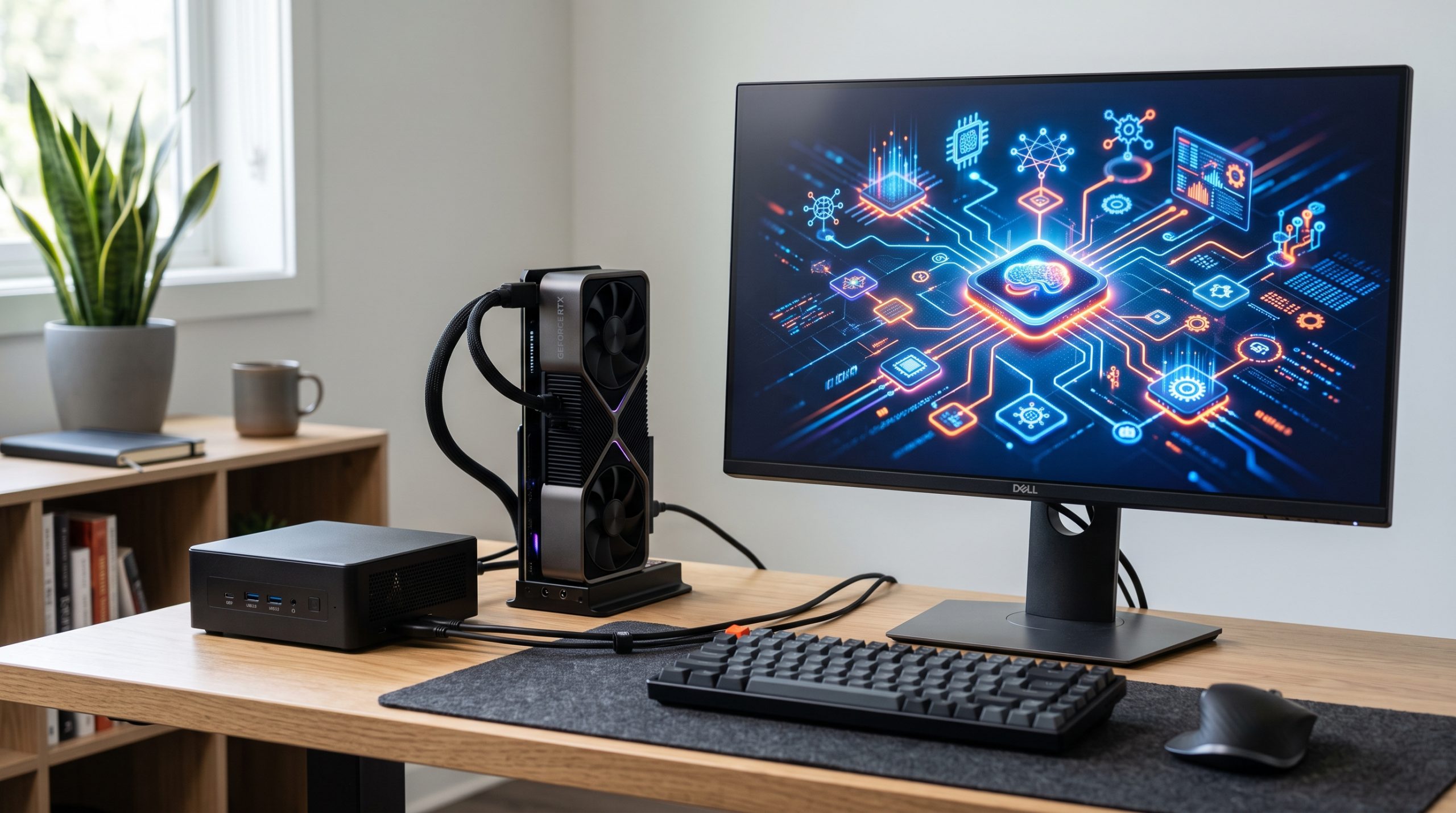
Marketing often leads with TOPS. That figure can help compare a narrow class of accelerator operations, but it does not answer the question that stops local deployments: where do model weights, the context window, and the KV cache live? A larger model at a lower bit width may technically load yet leave too little room for parallel users, retrieval results, or long agent sessions.
Two current product categories make the tradeoff clear. DGX Spark uses shared memory, which can make a large model easier to place in one address space. The RTX PRO 6000 Blackwell Workstation Edition uses 96GB of ECC GDDR7 and has a 600W maximum power specification, according to NVIDIA’s technical page. A discrete workstation GPU offers substantial dedicated bandwidth and predictable accelerator ownership. It also asks the team to budget for chassis airflow, power delivery, driver qualification, and a host with enough PCIe lanes.
Quantization changes the math, but it is not magic. A rough first pass starts with parameter count multiplied by bytes per weight, then adds runtime overhead and cache space. A 30B model at 4-bit weights needs roughly 15GB for weights before packaging and runtime overhead. Longer contexts increase cache demand. Multimodal models add image encoders and extra memory pressure. Teams should measure the actual serving stack rather than buying for a single screenshot of a model loading successfully.
Latency, privacy, and failure domains
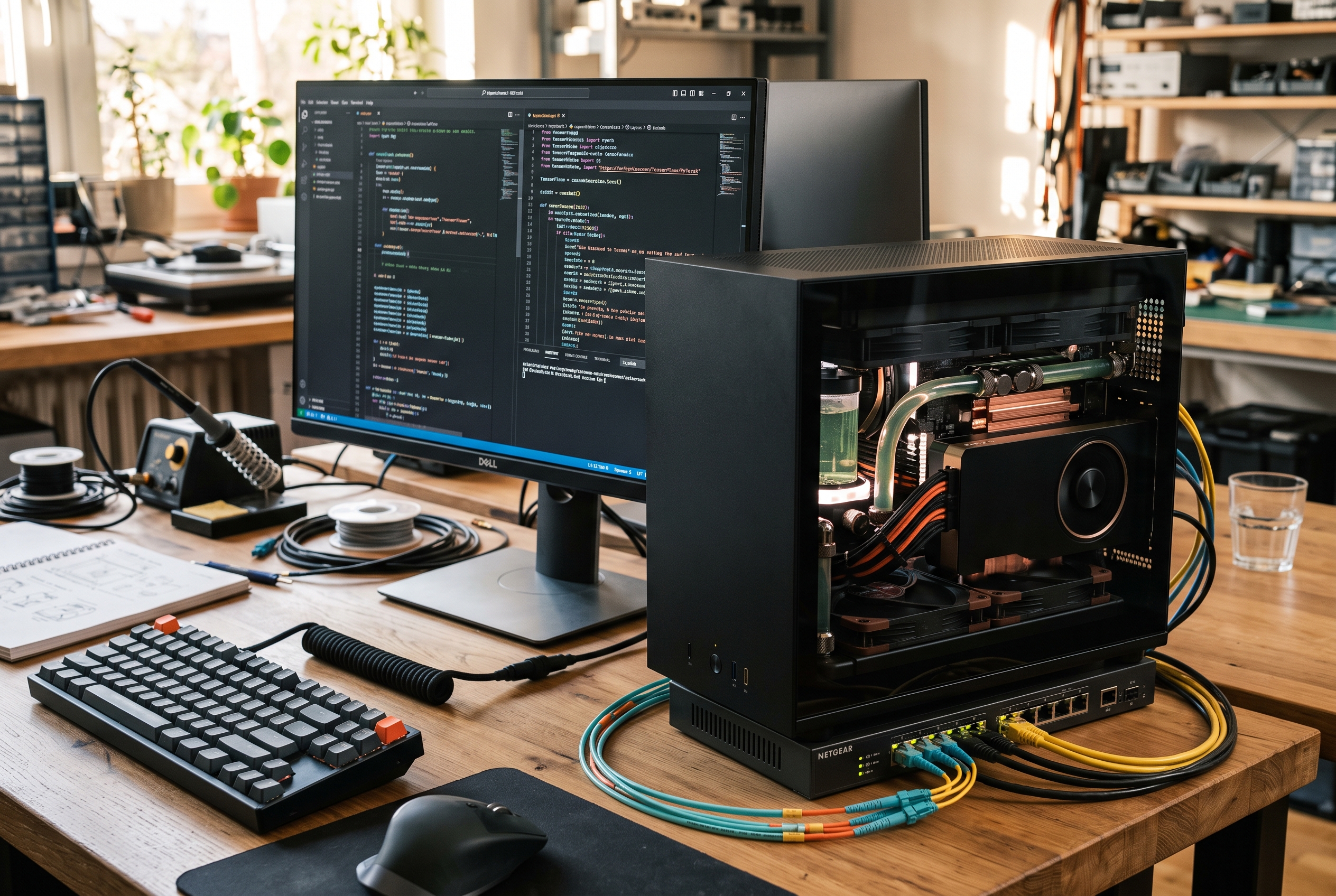
Local inference cuts the round trip between an application and its model server. That matters when an agent performs many small calls: inspect a repository, retrieve a document, produce a patch, run a test, then repeat. A few hundred milliseconds saved per step becomes noticeable across a long tool loop. It also makes offline or poor-connectivity operation possible for approved workloads.
Privacy is a stronger reason to keep some work local. Source code, contracts, support transcripts, and internal runbooks can stay inside the workstation or office network. That does not make the stack secure by default. Operators still need access control, encrypted disks, network segmentation, audit logs, and a clear retention policy for prompts and retrieved documents. A local model server exposed broadly on a corporate network is still a production service.
There is also a useful reliability boundary. A team can keep lightweight retrieval, classification, and coding assistance local while sending high-stakes reasoning or heavy video renders to a hosted system. That hybrid design avoids pretending that one machine replaces the cloud. It gives the application a graceful fallback when an external provider is slow, unavailable, or unsuitable for sensitive inputs.
What developers and infrastructure teams should change
Developers should define a workload before choosing hardware. Measure tokens per second, time to first token, concurrent requests, context length, and error rate. For agentic coding, test tool-call loops and repository scale, not only a one-shot benchmark prompt. For retrieval, test the embedding model, index size, and permission filters together. The slowest part may be storage or document parsing rather than inference.
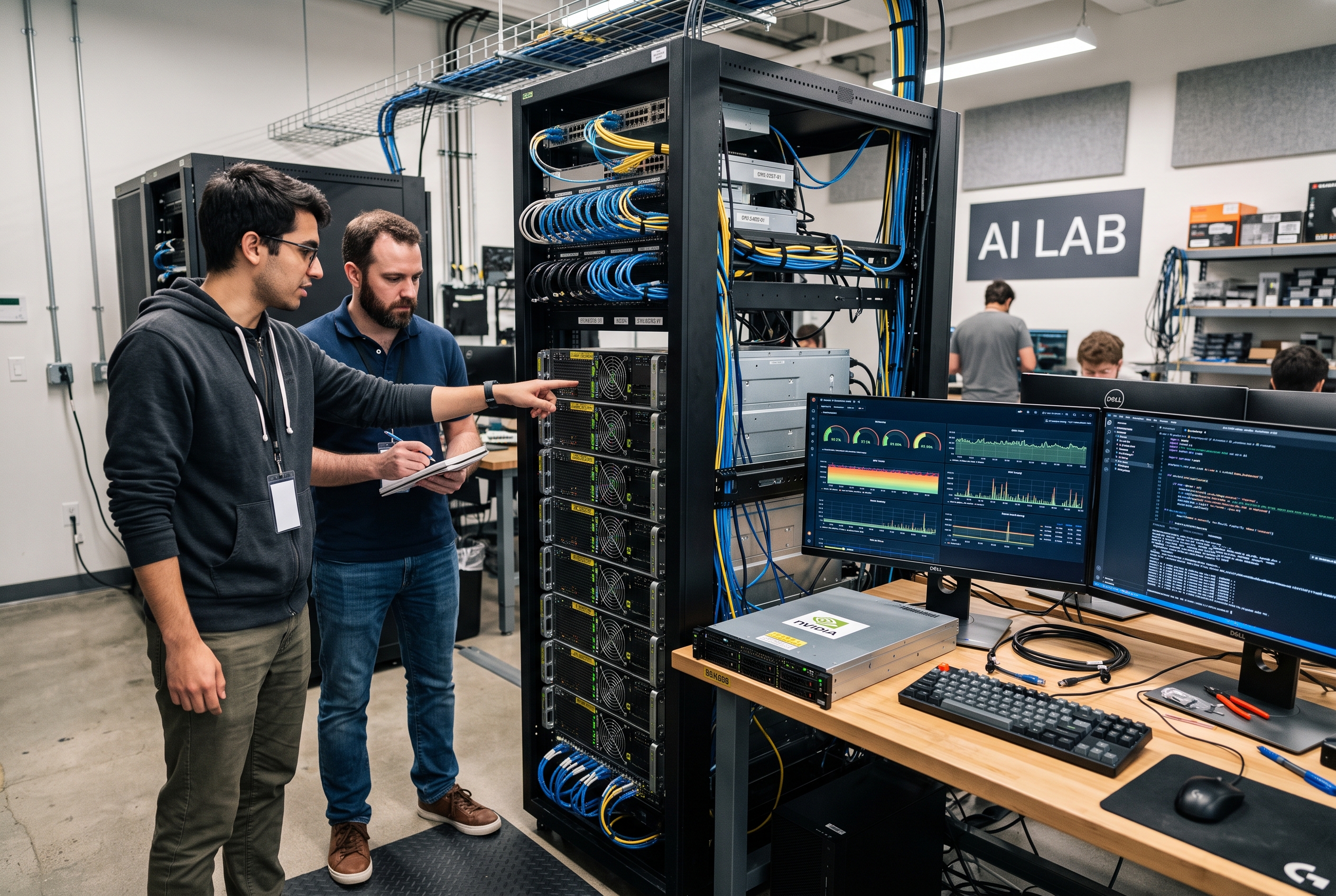
Infrastructure teams should treat the first workstation as a small service. Put the inference endpoint behind authentication. Pin model versions. Export GPU memory, temperature, utilization, queue depth, and request latency to the existing monitoring system. Set limits for context length and concurrency so one oversized request cannot starve everyone else. Keep a documented cloud fallback for jobs that exceed the local node’s memory budget.
Creative work still benefits from a mixed stack
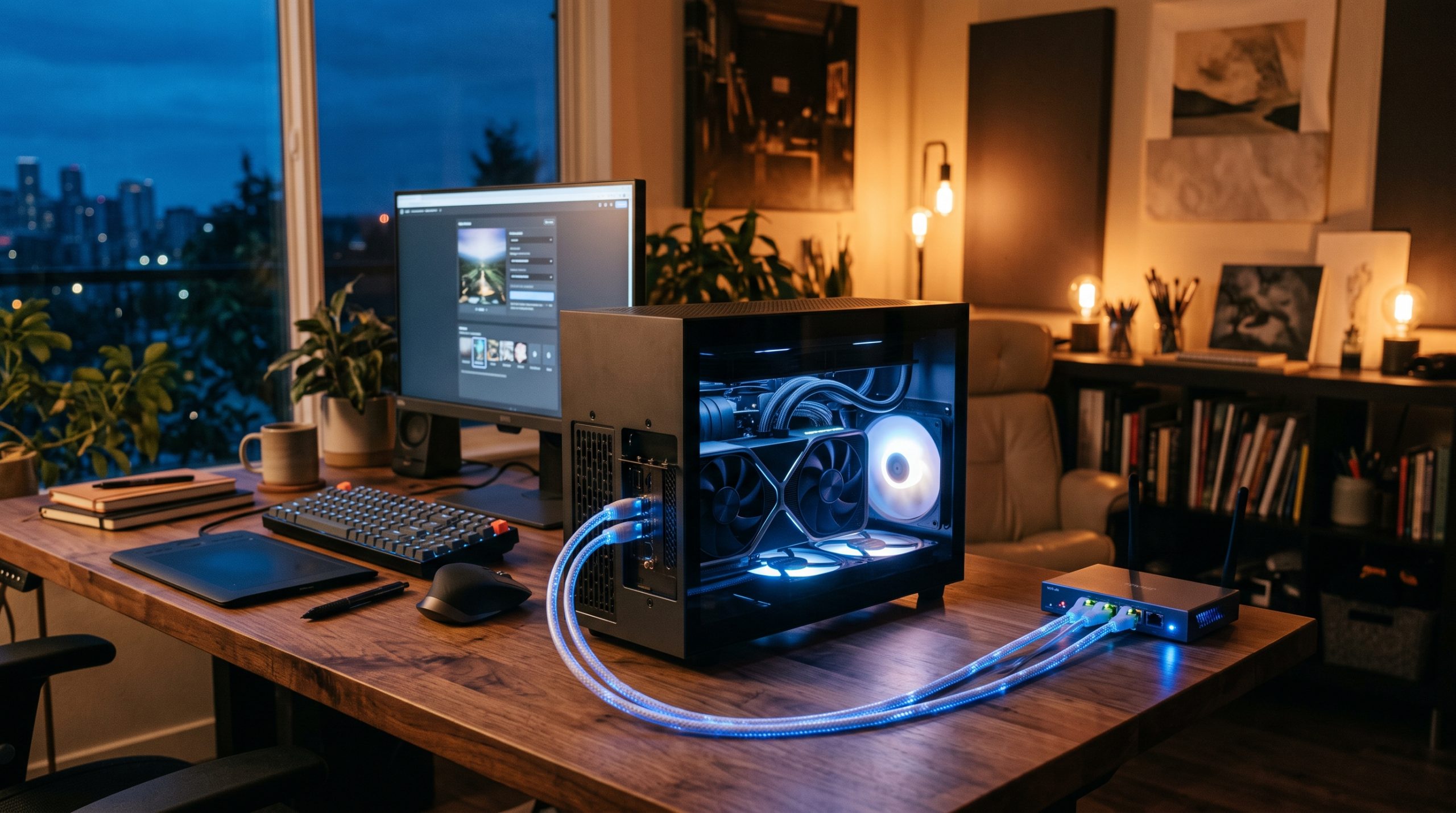
Local AI hardware also helps creative teams, even when final generation stays hosted. It can prepare assets, run small image transformations, index footage, redact material, and let artists iterate around a cloud render. The boundary moves as models improve. FastVideo Fast-H3, for example, is a four-step distilled MiniMax H3 implementation that generates synchronized video and stereo audio in 5 to 15 second clips. Its model documentation describes a 24 FPS, H200-backed preview. That is a reminder that video generation loads compute, memory, storage, and review workflows at once.
A practical local AI hardware checklist
- Choose the model and context target first. Buy memory for the real workload, not a generic TOPS figure.
- Budget for sustained power and cooling. A 600W accelerator changes the workstation and room design.
- Test the exact runtime, quantization, drivers, and model format before standardizing a fleet.
- Measure concurrent users and KV-cache growth, then set admission limits.
- Keep private data local only if identity, logging, patching, and network controls match the claim.
- Use cloud capacity deliberately for frontier models, burst demand, and heavyweight video work.
Local AI hardware is becoming an active part of the AI stack, not a hobbyist sidecar. The winning setup will be the one that matches memory, thermals, software, and governance to a specific job. Explore image and video models such as Nano Banana 2 and Fast-H3 on Wiro.