On-device AI has moved past the demo phase. Phones, laptops, and edge appliances now reserve silicon for local inference, but the useful change is not a headline TOPS figure. It is the ability to run a small model near the camera, microphone, files, and user without paying a network round trip for every request. That changes product design, capacity planning, and what privacy can mean in a real application.
Dedicated neural engines are appearing across client hardware because cloud inference remains the wrong default for many short, personal tasks. A voice command, document classification pass, image cleanup, or accessibility feature benefits from predictable latency and from keeping raw inputs on the device. The cloud still wins for large context windows and heavy generation. The practical architecture in 2026 is hybrid.
What on-device AI hardware actually changes
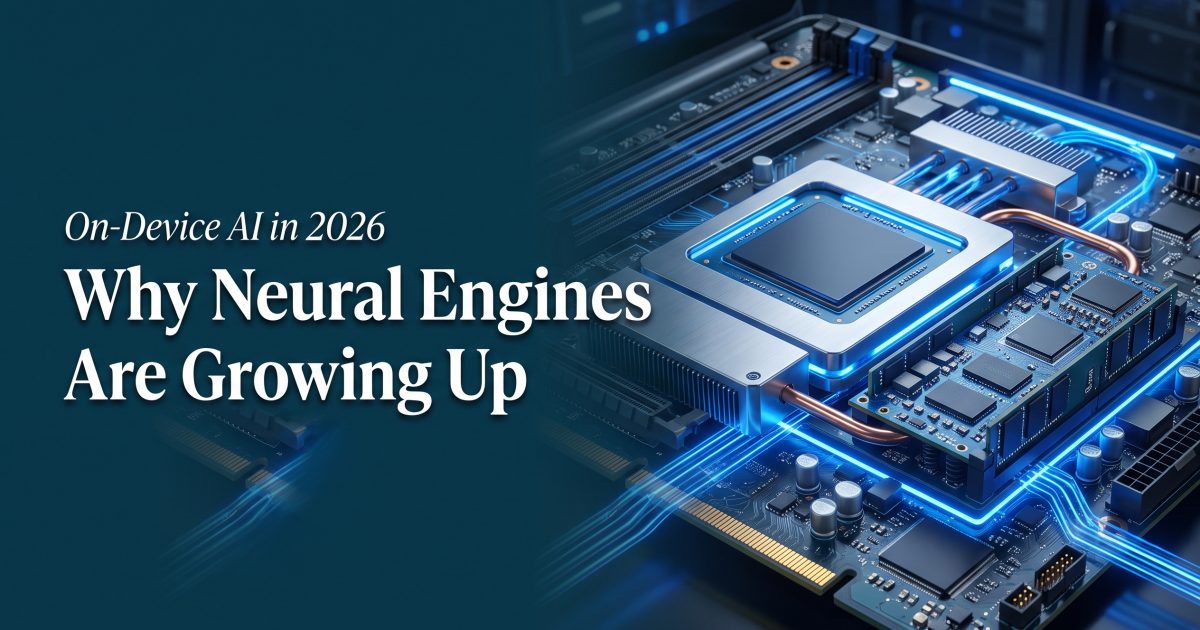
An NPU, Neural Engine, or AI accelerator is tuned for the matrix operations that dominate neural-network inference. It can often execute quantized models with less energy than a general CPU and without taking time away from graphics. The operating system still matters: memory bandwidth, supported operators, drivers, and model compilers determine whether an application reaches that hardware.
Microsoft sets a useful baseline for its Copilot+ PC class: more than 40 TOPS from the NPU. Qualcomm says its Snapdragon 8 Elite AI Engine improved AI performance and performance per watt by 45% over its predecessor. Those numbers show why vendors now treat local inference as a first-class workload. They do not tell a developer how quickly a specific model will answer.
On-device AI also changes the failure mode. A local feature can continue when a train Wi-Fi connection drops. It can avoid uploading a raw photo or recording before a smaller transformation. That does not make it automatically private. Telemetry, logs, backups, and fallback requests still need review. It does give product teams a smaller data path to secure.
Why TOPS is not a deployment plan
TOPS means trillions of operations per second. It is a peak throughput measure, normally quoted for a favorable numeric format. It does not include the cost of moving weights through memory, tokenization, prefill, decoding, image resizing, or an application waiting on a busy device. A 7B-parameter model quantized to 4 bits needs roughly 3.5 GB just for weights before runtime overhead. That single fact rules out many phone deployments even when the NPU score looks impressive.
Latency has two parts. Time to first result matters for a camera shutter, live caption, or autocomplete. Sustained throughput matters for a batch of documents, a long transcription, or multiple users on an edge box. Thermal behavior matters after the first 30 seconds. Battery drain matters after the first 30 minutes. Any on-device AI feature should be tested in all four conditions.
Use an independent suite where possible. MLPerf Inference: Mobile measures both speed and accuracy on trained models, rather than treating a silicon marketing number as a result. The suite is more informative than a generic benchmark because an application must preserve model quality while meeting a response-time target.
What developers should build for
Start with a task boundary, not a model brand. On-device AI is strongest when the input is already local and the result is short: speech enhancement, keyword spotting, OCR cleanup, semantic search over a local folder, visual quality checks, or a private classifier. Put a clear size budget around the model package and a timeout around inference. A local result that arrives after a cloud answer would have arrived is not a win.
Make the local path optional. Detect accelerator support, available memory, power state, and thermal pressure. Keep a CPU implementation for correctness and a remote path for work that needs larger models or current information. Cache model artifacts with version checks. Measure median and p95 latency separately; an average can hide a poor interactive experience.
Model format is part of the product decision. ONNX Runtime, Core ML, TensorFlow Lite, and vendor SDKs expose different operator coverage and quantization options. Test the exact exported graph on target hardware. A conversion that passes on a workstation can fall back to a CPU operator on a laptop, which changes both speed and battery use. Microsoft documents NPU access and device guidance for Copilot+ PCs in its developer guide.
What infrastructure teams should measure
Local inference does not remove infrastructure work; it redistributes it. Teams still ship model files, monitor version adoption, roll back bad releases, and decide when to route a request to a service. The difference is that request volume, GPU demand, and sensitive-data exposure can drop for the narrow tasks that stay local.
Track four numbers for each feature: local completion rate, fallback rate, p95 end-to-end latency, and energy or thermal cost. Segment them by device class and model version. A feature with a 95% local completion rate may reduce backend load substantially. A feature that falls back on half of older hardware may create a capacity spike unless the service budget includes it.
Also plan for model delivery. A 500 MB update is not a background detail on a metered connection. Use staged rollout, resumable downloads, integrity checks, and a way to remove a model without shipping a whole app update. Keep inputs and outputs out of diagnostic logs by default. On-device AI earns trust when that boundary holds under failure, not only in a diagram.
Practical takeaways
- Choose local inference for fast, repeatable tasks with local inputs and a strict privacy or latency need.
- Budget memory before choosing parameter count; quantization reduces weight size but does not erase runtime overhead.
- Benchmark time to first result, sustained speed, quality, heat, and power on real target devices.
- Build a hybrid route with an explicit fallback policy instead of forcing every prompt through either client or cloud.
- Treat model packages like production dependencies: version, sign, stage, observe, and roll them back.
The neural engine is growing up because software finally has a sensible division of labor. Local hardware handles the immediate and personal step. Remote accelerators handle the expansive one. The winning teams will not chase the biggest TOPS claim. They will choose the smallest model that meets the task, verify it on real devices, and keep the cloud available for the work that truly needs it. Explore visual AI workflows on Wiro.