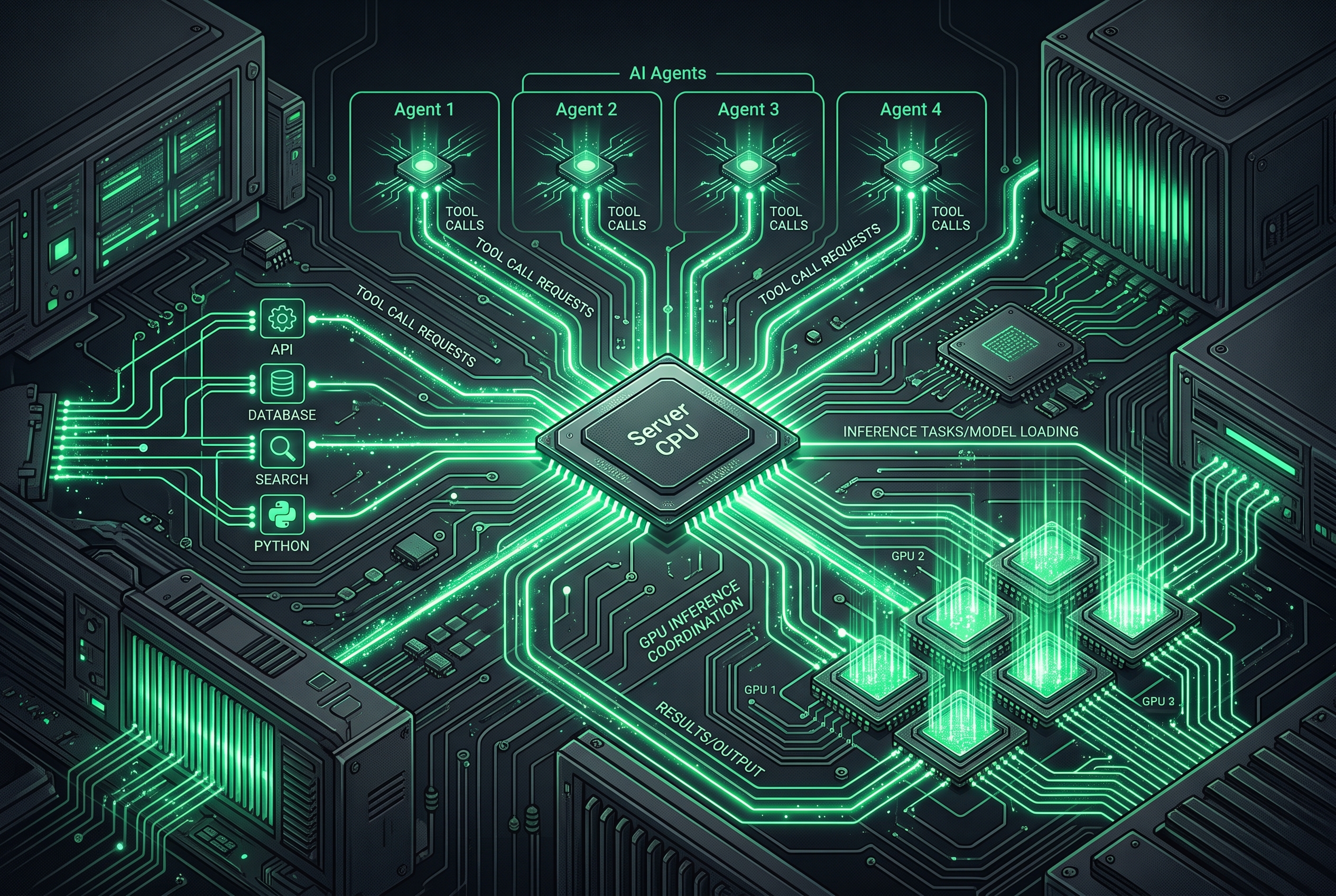
NVIDIA Vera CPU is a signal that agentic AI is changing the shape of an AI server. GPU throughput is still essential, but an agent does substantial work between model calls: starting sandboxes, searching context, calling APIs, executing code, checking outputs, and deciding what to do next. That work is often sequential, branch-heavy, and sensitive to tail latency. NVIDIA Vera CPU is designed for that orchestration layer, and it deserves to be judged as infrastructure for completed tasks rather than as a sidecar for a GPU.
NVIDIA Vera CPU and the agentic bottleneck
In its March 2026 launch, NVIDIA described Vera as a processor built for agentic AI and reinforcement learning. The company claims 50% faster results and twice the efficiency of traditional rack-scale CPUs. Those are vendor claims, not a universal benchmark result, but the design target is concrete. Agent systems can stall even while expensive accelerators are available if the control plane, retrieval layer, tool environment, or memory path cannot keep up.
Vera has 88 NVIDIA-designed Olympus cores. NVIDIA also cites up to 1.2 TB/s of aggregate LPDDR5X memory bandwidth and 1.8 TB/s of coherent bandwidth, while its technical architecture write-up describes a 164 MB unified L3 cache and up to 3.4 TB/s bisectional bandwidth from the Scalable Coherency Fabric. These figures point to the same workload: many concurrent execution contexts with irregular memory access, branch decisions, and data movement. They are very different from a uniform batch job that can simply maximize core count.
Why single-thread speed matters to agents
An agent loop has serial sections. A tool result arrives, code needs to parse it, a policy check chooses the next action, and a new request is assembled. Adding more CPU cores does not automatically make that path faster. NVIDIA says Olympus uses a 10-wide decode design, deep out-of-order execution, a neural branch predictor, and a graph prefetcher. The goal is to keep a single thread making progress through uneven control flow rather than waiting on misses and dependencies.
Vera also uses Spatial Multithreading with two hardware threads per core. According to NVIDIA, this partitions resources to reduce interference between threads and improve latency consistency under bursty workloads. That detail is especially relevant to infrastructure teams. Average response time may look fine while the slowest few agent runs suffer from cache contention, scheduler delays, or overloaded tool workers. Users notice the slow tail, not the benchmark median.
From a CPU to a rack-scale agent platform
The rack configuration matters as much as the core. NVIDIA announced a Vera CPU rack with 256 liquid-cooled CPUs and more than 22,500 concurrent CPU environments at full performance. That is a useful framing for teams running coding agents, browser-like tool sessions, retrieval workers, and isolated execution environments. It shifts the planning question from how many models can be served to how many complete agent sessions can move through the system without creating a hidden queue.
Vera also connects to the broader Vera Rubin platform through second-generation NVLink-C2C, plus PCIe 6.4 and CXL 3.1. In practice, those links determine how CPU-side orchestration, storage, networking, and accelerators exchange data. NVIDIA says a dual-socket configuration can appear as a single NUMA domain, potentially simplifying tuning. It is still worth validating the actual memory locality and data-placement behavior for a chosen framework, runtime, and model-serving stack.
What developers should benchmark
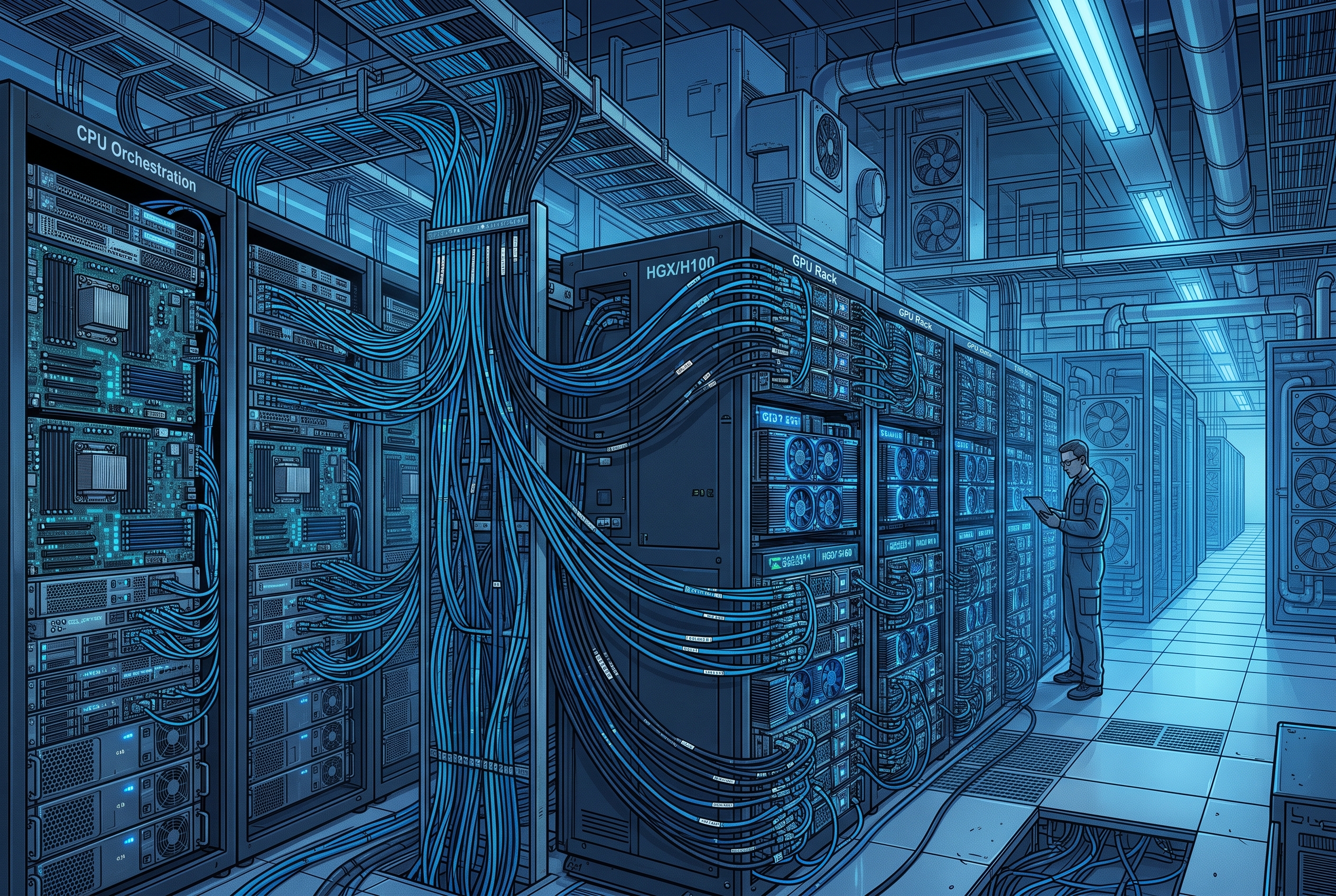
Do not benchmark only tokens per second. Start with an end-to-end task suite that includes retrieval, tool calls, parsing, code execution, model generation, and verification. Record time to first action, time to final answer, tool-call failure rate, retry count, p50 and p95 latency, CPU utilization, accelerator utilization, memory pressure, and cost per completed task. A fast model response does not help if tool work sits in a queue.
Test burst behavior too. Simultaneously start a realistic number of agent sessions and introduce slow tool responses, a retrieval miss, or a failed code run. Observe whether the platform isolates the disruption or lets it expand across the fleet. For security-sensitive applications, measure the cost of validation and audit steps rather than treating them as incidental overhead.
- Profile the CPU path: trace time spent in orchestration, embedding lookup, serialization, network waits, and sandbox startup.
- Check memory locality: verify where context, indexes, and worker processes land across NUMA domains.
- Test the tail: use p95 and p99 completion time under a burst, not only a clean single-session run.
- Measure useful economics: compare cost per verified completed task, including retries and human escalation.
What infrastructure teams should plan for
Vera also affects facility planning. Higher-density CPU racks, liquid cooling, storage bandwidth, and network fabric are coupled decisions. A team should match CPU environments to the GPU and network topology they support. Otherwise, a cluster can have idle GPU capacity while agent workers wait on a CPU pool, storage service, or east-west network path.
NVIDIA lists cloud providers and system manufacturers collaborating on Vera deployments, including Alibaba Cloud, CoreWeave, Meta, Oracle Cloud Infrastructure, Dell, HPE, Lenovo, and Supermicro. That ecosystem signal is meaningful, but it is not an availability guarantee for a particular region or configuration. Ask providers about delivered hardware, supported software versions, cooling limits, reservation terms, and how the instance exposes CPU, accelerator, and network telemetry.
The practical takeaway
NVIDIA Vera CPU is interesting because it makes an often ignored constraint visible. In agentic AI, the CPU is not merely feeding a GPU. It runs the stateful, latency-sensitive work that makes a model output useful. The winning infrastructure will be balanced across compute, memory, storage, networking, cooling, and software operations. Benchmark the full agent loop before purchasing capacity.
Sources
- NVIDIA Vera CPU launch announcement
- NVIDIA technical overview of Olympus cores
- NVIDIA Vera deployment update
Explore models and build your own agent evaluation assets on Wiro.