AI video effects are moving from a loose prompt-and-render exercise toward a defined deliverable. Instead of asking a general video model to invent a story, an effects model takes a known input, follows a fixed beat sheet, and returns a clip built for one format. That is why this category is gaining attention: it packages creative direction, identity handling, motion, framing, and sometimes audio into one repeatable inference job.
AI video effects turn a trend into a specified outcome
A general text-to-video system starts with a broad instruction. The user chooses the subject, action, camera work, timing, environment, and style. That freedom helps with original concepts, but it also creates more ways for a result to miss. A subject can drift between shots. A vertical crop can cut off the key action. A five-second clip may land on the wrong beat.
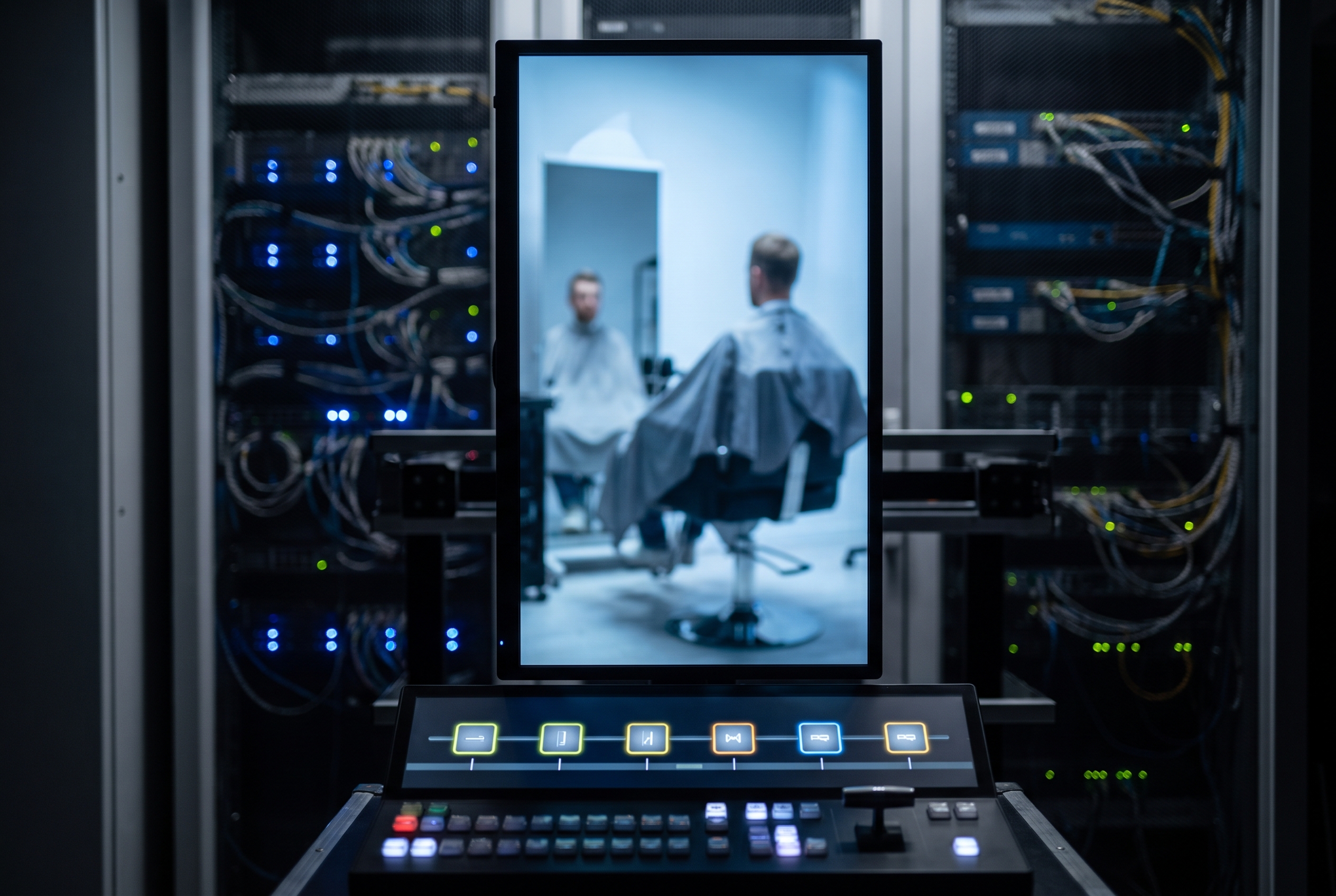
Outcome models narrow that search space. The model author decides the sequence before inference starts. The creator supplies the variable part, often a portrait, then receives a clip with a known social format and narrative arc. On Hair Cut Effects, the documented output is a vertical 9:16 MP4. Its 10-second version uses six fast cuts: a spoken setup, several snips, a finished bob reveal, hairspray, and a closing nape shot. The available duration options are 5, 10, and 15 seconds.
That specification matters. A creator is not buying a generic ten-second video. They are asking for a transformation sequence that has already been designed to read in a scrolling feed. The related Airplane Wing Stunt Trend follows the same product logic: the scenario is fixed, while the portrait provides the subject identity.
What changes technically in AI video effects
Video generation is expensive because time adds another dimension to the problem. The system must keep the subject, background, lighting, camera path, and action coherent across many frames. Modern systems usually avoid working directly at full pixel resolution for every denoising step. The Sora technical report describes compressing visual data into a lower-dimensional latent space, then representing it as spacetime patches for a diffusion transformer. It also describes outputs ranging from vertical 1080×1920 to widescreen 1920×1080.
Constrained effects do not remove that workload. They change the conditions around it. The output aspect ratio is known. The duration comes from a small set. The action plan is stable. The number and type of cuts are known before the job enters a queue. That gives a product team clearer targets for validation and capacity planning than an open-ended prompt interface.
This distinction should not be overstated. A fixed scenario does not prove lower GPU cost, lower latency, or better temporal consistency by itself. Those are measurements, not assumptions. Still, fewer free variables make it easier to set service-level targets and build regression tests. A team can test the same 10-second, 9:16 path across a representative portrait set instead of comparing unrelated scenes from thousands of prompts.
There is a useful precedent in research. NVIDIA’s Video Latent Diffusion Models work describes video as a resource-intensive synthesis task and uses compressed latent representations with temporal attention and 3D convolutions. The paper reports 512×1024 driving-video experiments and generation up to 1280×2048. The lesson is not that every effect tool uses that exact stack. It is that spatial detail and temporal consistency compete for memory and compute, so a well-scoped output can be a practical engineering choice.
Why developers and infrastructure teams should care
For developers, an outcome model looks closer to a parameterized API than a blank creative canvas. The useful inputs are explicit: portrait, scenario, ratio, duration, and sometimes style. The desired contract should be equally explicit: output MIME type, frame dimensions, expected duration, audio behavior, failure modes, and retention policy for source images.
That helps in three places. First, queues can be separated by class. A 5-second portrait effect should not necessarily wait behind a long, open-ended cinematic render. Second, observability becomes sharper. Track p50 and p95 time-to-first-byte, render completion, retry rate, moderation rejects, output duration, and download failures by scenario and duration. Third, caching and deduplication become more realistic. If the input asset hash and the effect parameters match, a platform can avoid sending the same request through inference twice.
Teams should also plan for the less glamorous path. Portrait uploads can be large. Video outputs require storage, transcoding checks, signed delivery URLs, and mobile-friendly playback. A 9:16 result may look right in a preview but fail after a social platform recompresses it. Native vertical output matters because it avoids a late crop that can remove hands, hair, or a final reveal.

A practical test plan before shipping an effect
Start with a controlled set of 20 to 50 consented portraits, not a single flattering sample. Include different hair textures, skin tones, glasses, hats, side profiles, low light, busy backgrounds, and frames where hands overlap the face. Run each supported duration. Then review the output at full resolution and after the intended delivery transcode.
- Identity: Does the person stay recognizably the same from the first frame to the last?
- Action: Does the main transformation occur on screen, without a missing hand or an impossible cut?
- Continuity: Do clothing, background, and hair color remain stable except for the intended change?
- Format: Does the file match the promised vertical ratio, duration, codec, and audio behavior?
- Safety: Are consent, age checks, impersonation controls, and reporting paths in place before public sharing?
Record failures as categories, not anecdotes. If 7 of 30 portrait tests show face drift after a close-up, that is a regression target. If the 15-second mode has a higher timeout rate, expose that separately in monitoring. This is the level where outcome models become operational products rather than a viral demo.
Where outcome models still fall short
The tradeoff is obvious: a predetermined sequence cannot offer the control of a general video model. A filmmaker who needs a specific camera move, a different ending, or a custom prop will hit the template boundary quickly. Even a strong identity-preserving effect can struggle with occlusions, unusual lighting, fast hand motion, or a portrait that lacks enough visual information.
There are also governance questions. Portrait-to-video systems should make consent visible in the product flow. They need clear rules for minors, public figures, sensitive transformations, and source-image deletion. The fact that an effect has a short duration does not make those issues smaller.
The larger trend is practical, not mystical. General video systems are getting better at broad simulation and cinematic control; Google’s Veo page positions the model around cinematic video with audio. Outcome models take the other path. They make a single familiar result easier to request, test, and deliver. For developers, that means a tighter API contract. For infrastructure teams, it means clearer queues, metrics, and acceptance tests. For creators, it means less time negotiating with a blank prompt box.
Explore current video models and effects on Wiro to compare the open-ended and outcome-first approaches for a real production workflow.